When you open a Zhengdao company or institution party page from the lists tool, you are reading an orientation map of sourced public notices and identity leads—not finishing a transaction decision. You check official Chinese names and aliases, list-type chips, aggregate status, digital-identity fields, key people and sourced official records. Your name match or website match starts verification; it does not decide clearance, prohibition or licensing for your shipment. This page is literacy only, not legal advice.
When you use a party page vs the lists search hub
You open a party page when you already have a candidate company or institution row—or when you land on one from search—and you need to read that card’s sections with humility. You use the lists search hub when your first job is still locating a party by name, website, domain or email domain. For the search method itself—hit humility, no-match humility and how public-list evidence stays separate from digital identity on result cards—you already have How to Screen a Counterparty on Zhengdao’s China Export-Control Lists (Without Over-Reading a Hit) once; this article does not rewrite that hub walkthrough.
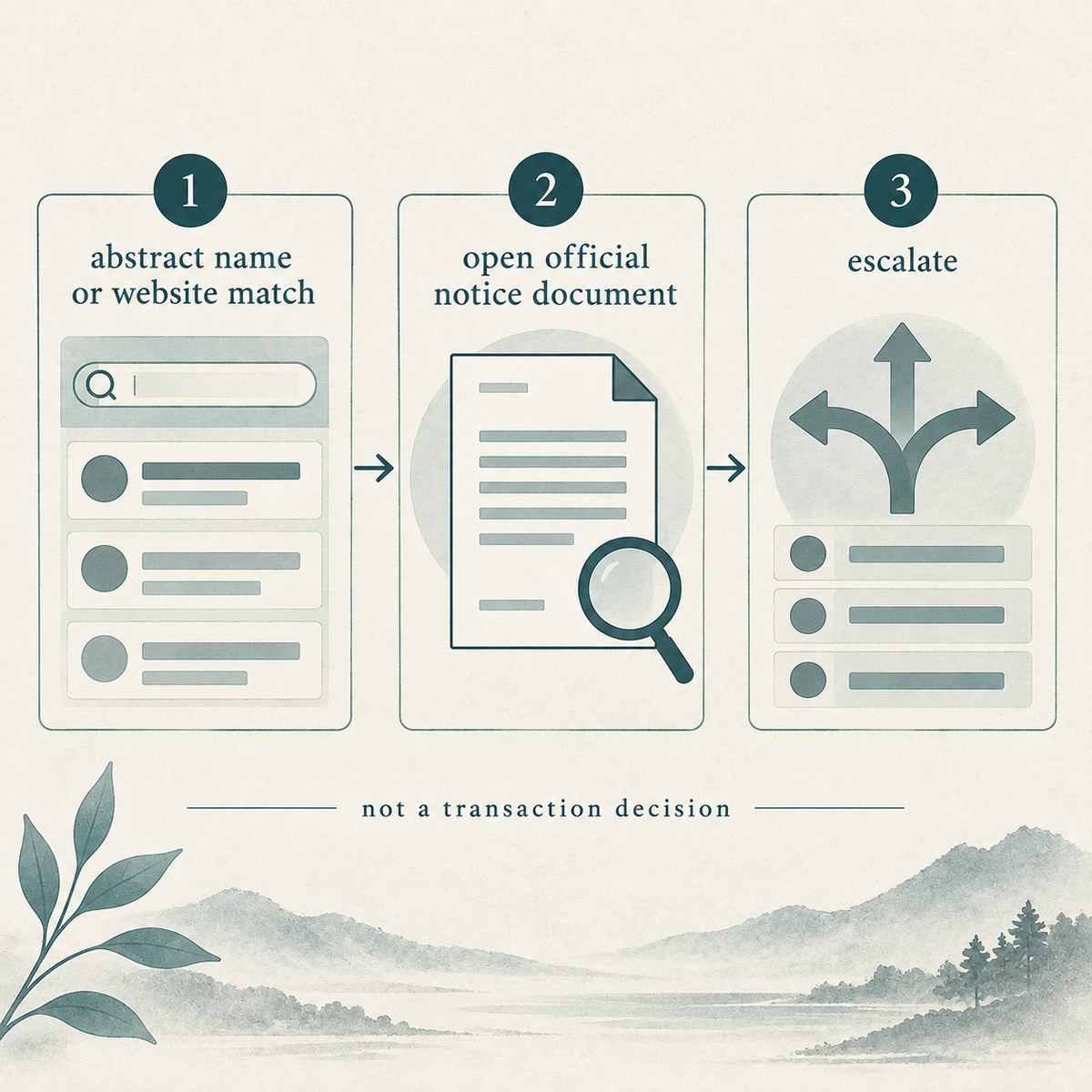
You treat the two surfaces as one workflow with two moments. First you locate; then you read the party page as structured notice evidence plus identity leads. You still open the governing Chinese source, compare status for your transaction date and escalate when the page cannot answer your shipment question.
Anatomy: Chinese name, list chips, aggregate status, verification stamps
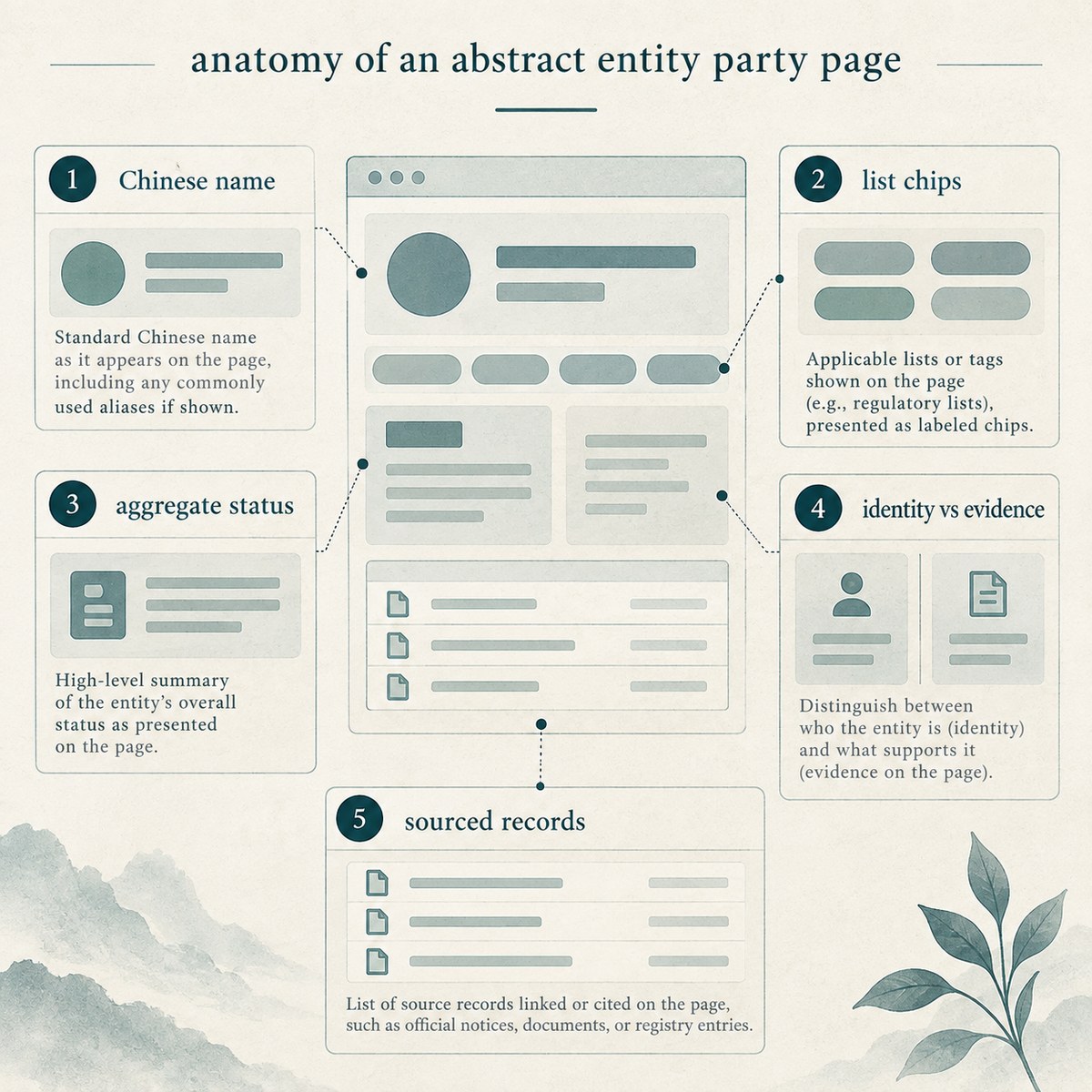
You start with the official Chinese name and any aliases or former names the page shows, because listing instruments are published in Chinese and English marketing labels can miss. You then read the list-type chips on the card—examples on live pages include Export Control List, Unreliable Entity List and Countermeasure List when those instruments apply to that party—and you read the aggregate status language such as “In force” as a disclosed snapshot for the verification date, not as a permanent clearance or permanent ban for every future deal.
You also re-check the verification stamps. On live party pages and the lists hub, Zhengdao discloses that the full dataset was verified through 2026-08-22 and that data was updated 2026-09-21 08:21:11 (UTC+8) when this article was last checked; you treat those stamps as snapshots and you re-read the live page when you return. A useful layout illustration—an example only, not a judgment about that company—is Lockheed Martin Corporation, whose party page shows entity type Company or institution, country United States, official Chinese name 洛克希德·马丁公司, the three list chips named above, aggregate status In force, and a direct-answer style line stating this database has 4 sourced records for that party on the disclosed verification date.
You use that example only to learn the anatomy. The same page states that the same entity may have records that are in force, suspended or ended; that the page preserves historical facts; and that a name match alone should not determine a transaction decision. Your job is orientation: match the Chinese identifiers, notice which list chips appear, note the aggregate status and stamps, then keep reading—do not stop at the H1.
Digital identity vs public-list evidence—and shared-domain caution
You keep public-list evidence (the notice trail and list chips) separate from counterparty digital-identity fields such as a website lead or an email-domain candidate. On the Lockheed illustration, Zhengdao shows a website lead of www.lockheedmartin.com as reference only and an email-domain candidate of @lmco.com marked as a technical candidate only—derived from a public website or subject reference, not proof that the organisation receives mail on that suffix. You compare those leads with the named legal entity; you do not treat a website match or email-domain match as automatic proof that the sender is authorised.
You also watch for shared-domain caution. The same illustration warns that the registered domain is also connected to other list records and tells you to check the legal name, address and email signature. A domain that appears on several cards is a reason to slow down, not a reason to invent a group determination from the screenshot alone. Your identity block is navigation evidence; your listing block is public-notice evidence; joining them still requires your transaction facts and, when stakes are real, qualified review.
Key people and sourced official records
You read the key people section as persons named in official notices—with positions and list chips as disclosed on the page—not as a private org chart Zhengdao invented. Those rows help you see which executives or associated persons appear in the same notice trail as the organisation. You still open each linked record when identity or measure detail matters for your case, and you do not treat a person’s presence on the page as a finished personal-screening decision outside the notice text.
You then read sourced official records newest first. On the Lockheed illustration, the page discloses 4 records with issuing authority, publication and effective dates, measure-summary wording drawn from the Chinese source, and a path to Open official Chinese source. You treat measure summaries as orientation to the notice language—not as a complete translation substitute—and you open the official Chinese text before you rely on any measure for your shipment date. Status can change: records may be in force, suspended or ended, and later notices can amend earlier ones. Your audit trail should include which notice you opened and which status language you compared to your transaction date.
A name or website match is not a transaction decision
You should treat every party-page match as orientation, not as a finished “blocked / clear / licensed” answer for your exact shipment. The live Lockheed page’s own boundary language says a name match alone should not determine a transaction decision, and the page footer frames the surface as a structured index of public notices—not legal advice or a real-time screening decision. The official text and any subsequent changes prevail.
You escalate when list types, status language, ownership, end use, destination or other regimes remain open. For watch-list versus control-list legal-effect literacy on one export transaction—after you already know which instrument lane you are in—you open Watch lists vs control lists: how to check and act on one export transaction once; this article does not rewrite that doctrine. Keep Editorial and regulatory verification policy nearby when you need Zhengdao’s sourcing and “not legal advice” boundary in one place. Your workflow stays: orient on the party page, open the Chinese source, switch literacy tools when the question changes, then escalate.
Orient on the lists hub—then read the party page with humility
When you are ready to locate a company, institution or person—and to treat every party page as orientation rather than a decision—open Paste a name or email domain. Find the party behind it. and keep name-match humility beside you. You are using Zhengdao’s entity party pages to read sourced notices and identity leads, not to finish a transaction determination. Orient, open the official Chinese source, then escalate when your case needs a judgment these pages cannot give.