1. First separate the two lists
Direct answer: a watch list covers end users or end uses that cannot yet be verified. A control list covers higher risk, or confirmed violations or harm. Both change whether this shipment can proceed and which licence path remains open. The intensity of the required action is not the same.
The Regulations on Export Control of Dual-Use Items (State Council Order No. 792) place both systems in the same chapter:
- Watch list (Article 26): the commerce authority may list an importer or end user that fails, within the prescribed period, to cooperate with verification or to provide supporting materials, so the end user or end use cannot be verified.
- Control list (Article 28): listing may follow a violation of end-user or end-use management requirements, conduct that may endanger national security and interests, use of dual-use items for terrorist purposes, or similar grounds. A party may also be moved up from a watch list.
In practice, ask two questions first. Is the customer “unable to explain / unwilling to cooperate with verification”? Or has the case already reached “prohibit or restrict the transaction”? A wrong answer sends the licence path the wrong way.
2. A watch-list hit tightens the channel; it is not an automatic ban
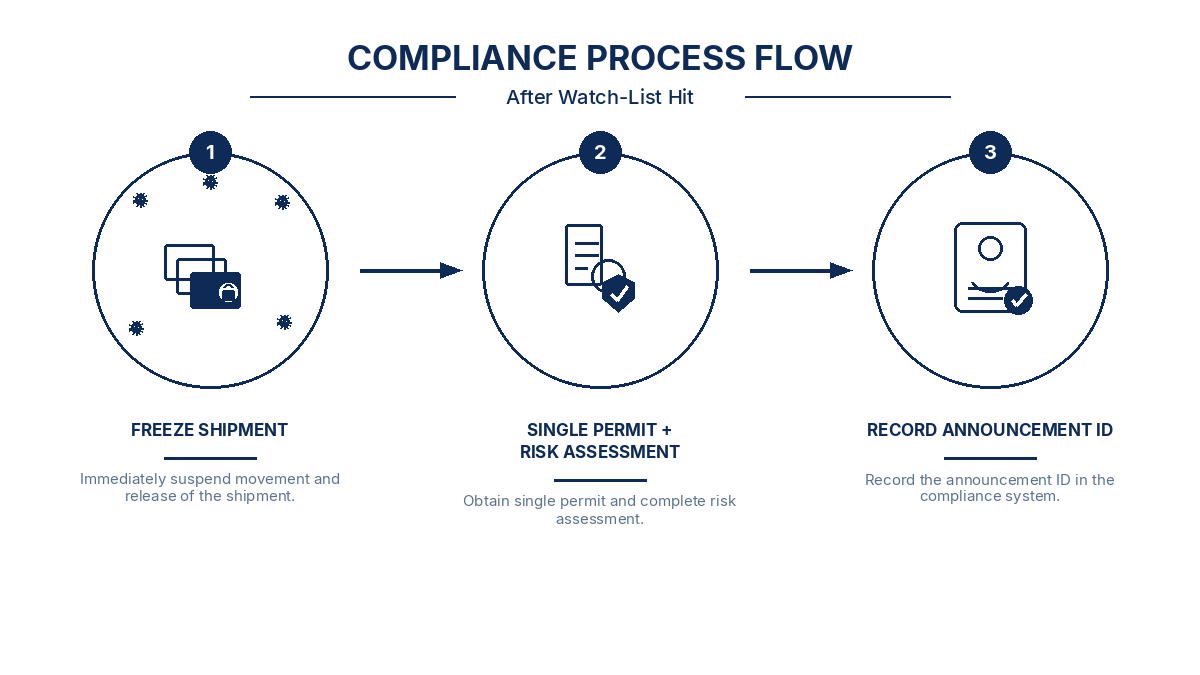
Article 26(2) of the Regulations: when exporting dual-use items to a watch-listed party, (1) a general licence may not be applied for; (2) an export certificate may not be obtained by registering and filing information; (3) an individual licence application must include a risk-assessment report on that party and an undertaking to comply with export-control laws, regulations and related requirements; (4) the licence review period is not limited by Article 17(1) of the Regulations (usually 45 working days).
Individual announcements may add detail. For example, MOFCOM Announcement No. 12 of 2026 requires an extra written undertaking for individual licence applications: not to use the dual-use items for any purpose that helps enhance Japan’s military capabilities. It also states that exports involving military users, military uses, and related end users or end uses will not be approved. Each transaction must follow the full text of the announcement then in force.
Action: watch-list hit → stop using the general-licence or registration-certificate path → freeze shipment → complete the risk assessment and undertaking → file for an individual licence → record the announcement number, the annex list version, and the search date.
3. A control-list hit follows the announcement; special cases need an application
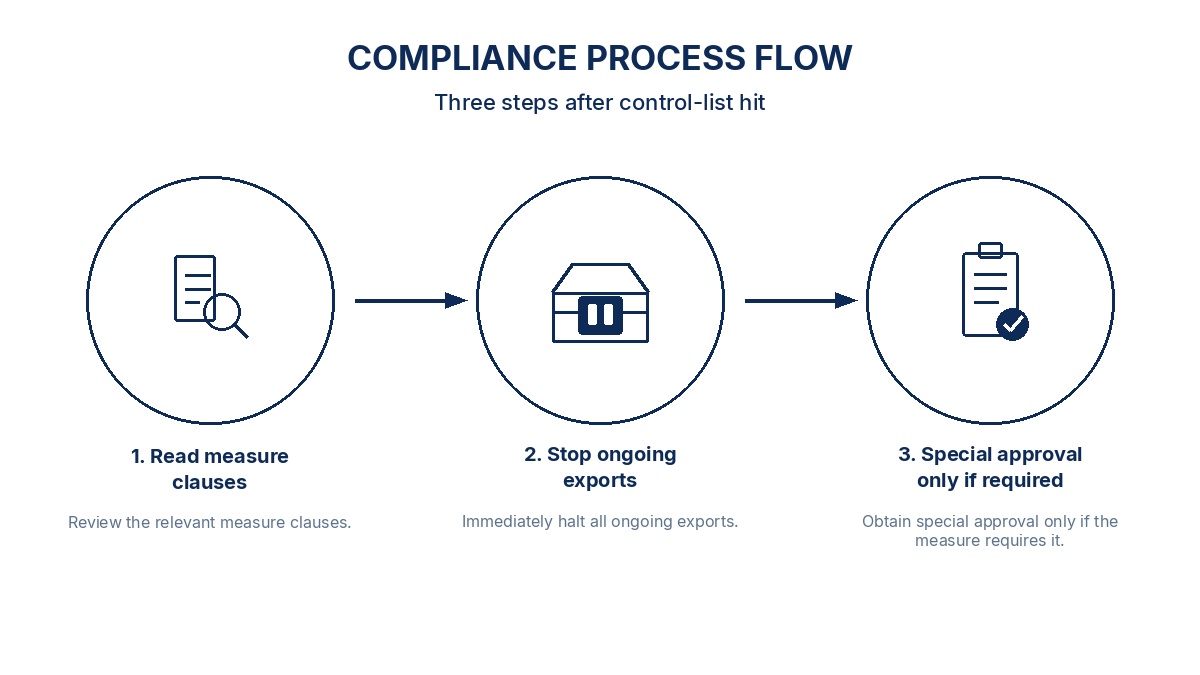
Article 29 of the Regulations: the commerce authority may prohibit relevant dual-use transactions with a control-listed party, restrict such transactions, or order exports to stop. Exporters must not conduct relevant dual-use transactions with a control-listed party in violation of the rules. Where a transaction is truly necessary in special circumstances, apply to the commerce authority, proceed only after approval, and report as required.
MOFCOM Announcement No. 27 of 2026 states, for 20 listed entities: dual-use exports to them are prohibited; overseas organisations and individuals must not transfer or provide dual-use items originating in China to those entities; related ongoing activities must stop immediately; where export is truly necessary in special circumstances, apply to MOFCOM.
Action: control-list hit → read the measure clauses in that announcement → stop in-transit and after-sales related export activity → start a special application only if the export is truly necessary and you are prepared to seek approval.
Article 30 keeps a removal path. A watch-listed party may also be removed after cooperating with verification and after the facts are verified (Article 26(3)). Removal depends on the competent authority’s decision.
4. A minimum screening flow for one export
- Name the parties: buyer, consignee, end user, intermediaries, payer, and installation or maintenance parties.
- Screen the public lists: legal name, English name, former names, and official domain. Use the on-site counterparty screening entry to locate a lead across China measures and the official foreign files, then open the official text to check the annex and the effective date.
- Identify the list type: watch, control, countermeasure, or other public restriction. After a hit, read the measure clauses.
- Align the item and the end use. For red flags, see /en/articles/red-flags/.
- Write the review into the file. Keep records for at least five years (Article 27).
Important boundary: the on-site list database is an index of public announcements. A miss does not mean there is no other compliance risk.
5. Three things that can start today
- One page: watch list → individual licence plus risk assessment; control list → read the announcement measures first, and stop at once if the measure is a prohibition.
- Enquiry forms must capture the end user’s full legal name and one sentence on end use.
- Put /en/item-screening/ and /en/entity-screening/ on the same review ticket.