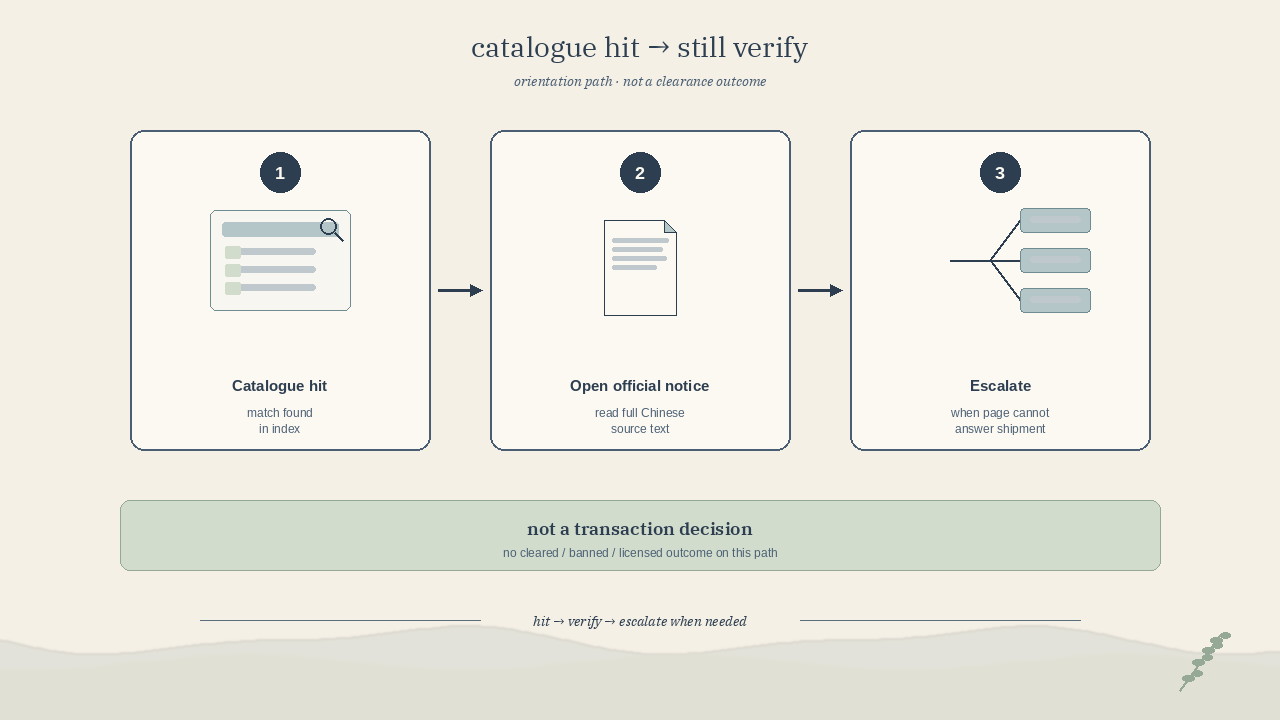
When you open a Zhengdao import–export control catalog item page, you are reading an orientation map of one structured official measure—not finishing a transaction decision. You check the direct-answer hit language, the Chinese item name, the control-code or announcement pointer, any HS grouping under a 2026 tariff line, category, dates and status stamps. Your catalogue hit starts verification; it does not decide clearance, prohibition or licensing for your shipment. This page is literacy only, not legal advice.
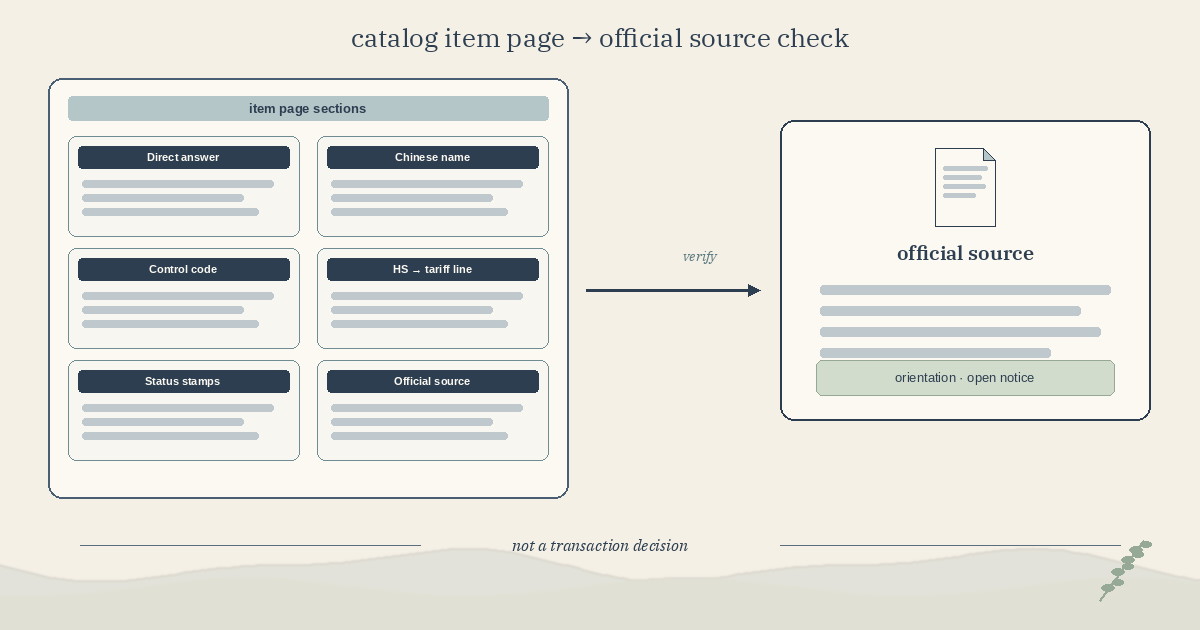
When you use an item page vs the catalog search hub
You open an item page when you already have a candidate measure row—or when you land on one from search—and you need to read that card’s sections with humility. You use the catalog search hub when your first job is still locating a product or technology measure by name, CAS, control code or HS digits. For the search method itself—match humility, no-match humility and English-subset coverage—you already have How to Use Zhengdao’s China Import–Export Control Catalog (Without Over-Reading a Match) once; this article does not rewrite that hub walkthrough.
You treat the two surfaces as one workflow with two moments. First you locate; then you read the item page as structured measure evidence plus a path to the governing Chinese text. You still open the official source, compare scope for your transaction date and escalate when the page cannot answer your shipment question.
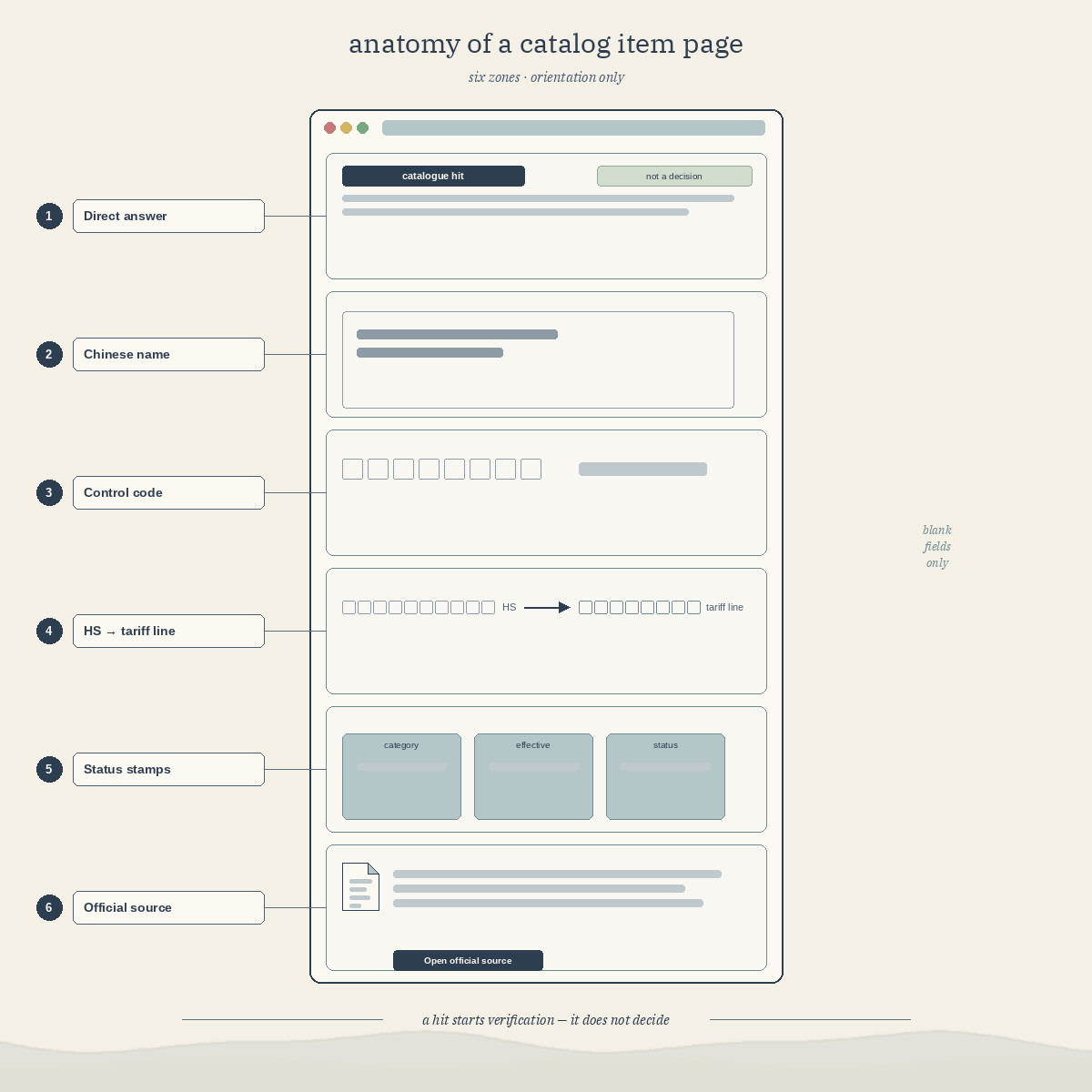
Anatomy: direct answer, Chinese name, control code, HS grouping, stamps
You start with the direct-answer block. On live item pages it states whether the product or technology appears in a current official import/export measure, names the measure type, and says plainly that a catalogue hit is not a final transaction decision. You also keep the safety lines in view: a match means verify the official text; no match does not prove the item is uncontrolled; the index is not legal advice.
You then read the Catalogue record. Prefer the Chinese item name when it is shown, because catalogue language is authoritative in Chinese. Read the control code or announcement pointer (for temporary measures this is often a MOFCOM/GACC announcement citation), then any HS block that groups 10-digit commodity codes under their matching 8-digit 2026 China tariff line. You treat those HS digits as a search index and a bridge to the tariff book—not as the determination basis for dual-use or other control status.
A useful layout illustration—not a money CTA—is Helium. That live page shows measure type Temporary export prohibition, Chinese item name 氦气, control code 商务部 海关总署公告2026年第29号, 10-digit 2804290010 mapping to 2026 tariff line 28042900, category 临时禁止出口管理, effective date 2026-07-10, official status 现行有效, full source verification through 2026-08-22, and catalogue data updated 2026-09-22 22:32:52 (UTC+8) at the time of this draft’s live curl. You re-check those stamps on the live page whenever you return—draft-day figures are not permanent coverage.
English rendering vs the Chinese official text
You read the Reviewed English rendering of the catalogue excerpt as a navigation aid, not as a complete translation substitute. Live item pages state that the working English rendering supports navigation and that the linked Chinese official text controls. Your next move after orientation is Open official source, then compare complete item description, technical notes, exclusions, destination scope and any later adjustments with your real goods or technology facts.
You also keep category language humble. A browse label such as temporary export prohibition helps you choose which official text to open first; it does not invent a sample ruling for your exact SKU, route or end use. If your confusion is specifically customs tariff identifiers versus dual-use or other control codes, open HS Codes vs Control Codes: When Tariff Lookup Is Not Enough once; that article teaches identifier systems, while this one teaches how to read one catalog item card.
Verification boundary—and why a hit is not a decision
You should treat the Verification boundary section as the page’s own humility checklist. Live item pages state that names, codes and commodity numbers are search indexes; they do not replace the complete scope, technical notes, exclusions or licensing rules in the official text. You confirm product or technology name, function, specifications and parameters; you compare complete control scope and exclusions in the official source; then you review destination, parties, end user, end use and any catch-all requirements.
You likewise refuse to treat a catalogue hit as a finished “banned / licensed / clear” answer for your shipment. The helium illustration’s direct answer says the page is a catalogue hit and not a final transaction decision, and it tells you to check the linked notice for scope, exceptions and destination before you verify end user and end use. Status and catalogue data can change; your audit trail should show which official text you opened for which date.
Keep Editorial and regulatory verification policy nearby when you need Zhengdao’s sourcing and “not legal advice” boundary in one place. Your workflow stays: orient on the item page, open the Chinese official source, switch literacy tools when the question changes, then escalate.