Practical guide

NCM, HTS and CN Codes vs China Tariff Lines: What the Shared First Six Digits Do and Do Not Tell You

When you carry an NCM, HTS or CN code into a China tariff search, only the first six digits are shared. Confirm the Chinese line on its own text. Not legal advice.

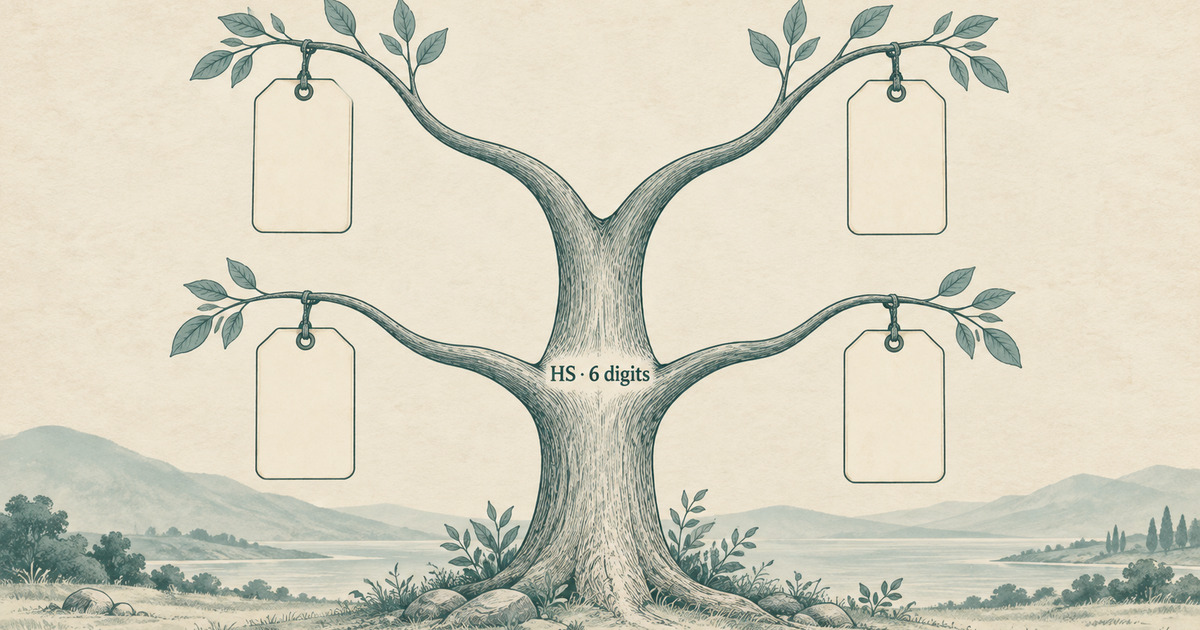
Schematic: four national code strings share one six-digit HS stem, then branch into separate national extensions — a shared stem is not a matching China tariff line

When you carry a Brazilian NCM, a US HTS or an EU CN code into a China tariff search, you share only the first six digits by design. The World Customs Organization fixes those six; every country or customs union writes its own extension. You can use the stem to find candidate China lines, but you still confirm the Chinese line on its own text. This page is general information, not legal advice or a classification ruling.

Why your code and China’s line look almost the same

You see near-identical strings because most customs tariffs are built on the same base. The World Customs Organization describes the Harmonized System as more than 5,000 commodity groups, each identified by a six-digit code, used by more than 200 countries and economies as the basis for their customs tariffs. You are therefore looking at a common international stem with a national tail, not two copies of one national code.

You notice the trap when the tail also matches. An NCM 8424.90.90 and a China line 84249090 can look identical digit for digit, and on the China side 84249090 is “其他” (other) in the 2026 schedule. You cannot read the identical string as proof that the two descriptions, the notes or the splits beneath them are the same. Each tail is written by a different authority for its own tariff.

Who writes each extension

You can verify the split for each system on its owner’s own page:

  • HS (six digits): the World Customs Organization maintains the six-digit nomenclature and its legal structure.
  • NCM (eight digits): Brazil’s Receita Federal states that the first six digits of the NCM follow the HS by international convention and the last two digits are defined by Mercosur.
  • EU CN (eight digits): the European Commission describes each CN code as an 8-digit code number followed by a description and a duty rate, with additional notes for EU-specific additions.
  • US HTS and Schedule B (ten digits): the US International Trade Administration says the United States uses a 10-digit number for imports (HTS) and exports (Schedule B), that the full numbers may differ, and that the first six digits will be the same.
  • China (eight-digit 税则号列, with 10-digit declaration codes): Zhengdao’s 2026 China tariff pages show the 8-digit tariff line and, where ingested, official 10-digit children beneath it.

You take one practical rule from this list: digits seven and beyond belong to whoever published that tariff. You never port them across borders without reading the target book.
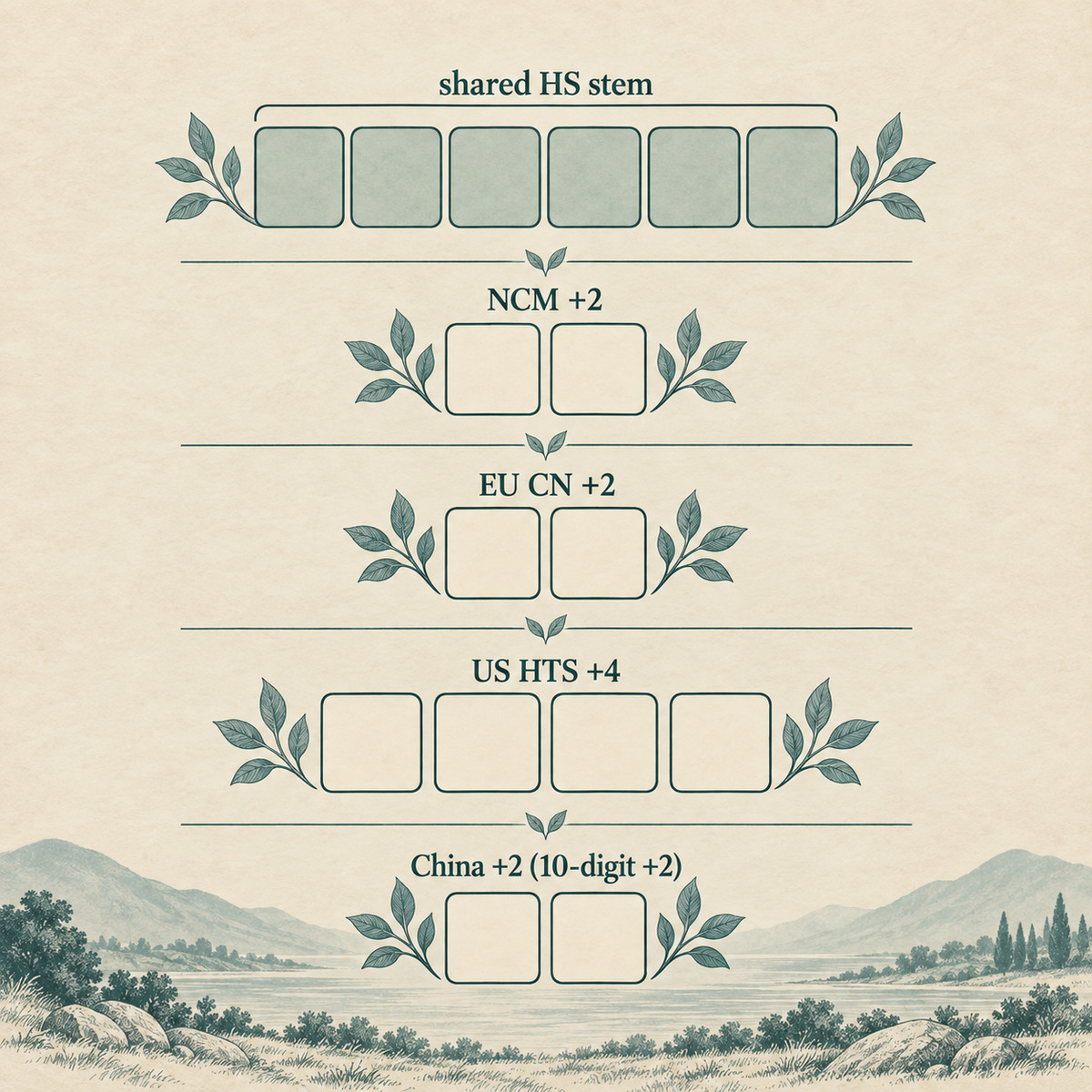
Schematic: one shared six-digit HS stem with four separate national branches — Mercosur NCM, EU CN, US HTS, China tariff line — each tail written by its own authority

How you move from a foreign code to candidate China lines

You start by cutting your code back to six digits. That is the only part you can expect to share with China. You then search the China tariff hub at the six-digit level, so you see every 8-digit China line inside that subheading instead of jumping straight to the one string that happens to match yours.

You next read each candidate on its own terms. You compare the Chinese product name, the heading and subheading notes, and the description of your actual goods: function, material, model and use. You pick a candidate because its Chinese text fits your product facts, not because its last two digits echo your NCM, CN or HTS code. You keep a note of which candidate you chose and why, so a later reviewer can follow your reasoning.

You also check that both books are on comparable editions. The International Trade Administration notes that the HS is updated every five years, and national tariffs follow on their own timetables. When your foreign code comes from an older schedule, the six-digit stem itself can have moved, so you confirm the stem before you trust it as a bridge.

What a China line page adds beyond the six digits

You learn the layout once on a live example such as 84249090 其他. The page states that 8-digit tariff line 84249090 is “其他” in the 2026 schedule and that it does not decide classification, origin, quota or the rate that applies to a shipment. It shows its rate columns, its year stamp of 2026 with effect from 1 January 2026, and a note that the 8-digit book was last verified on 2026-07-15.

You then read the 10-digit block. On draft day the page lists one ingested child, 8424909010 (高压水炮主要部件及配套设备), opened from an official source the page labels as the dual-use export licence catalogue. The page says duty rates stay on the 8-digit line and that its 10-digit children are a partial corpus, not a complete national 10-digit book. You re-check those stamps whenever you return, because draft-day details are not permanent coverage.

That child is the clearest reason not to stop at a matching string. A searcher arriving with NCM 8424.90.90 would see nothing in their own code that points to an export-control catalogue entry on the China side. You treat the label as a pointer to more reading, not as a finding about your goods either way.

Tariff match versus control status

You keep two questions apart even when one code string appears in both. A tariff line tells you where goods sit in the customs book; it does not tell you whether an item or technology is controlled. Zhengdao’s explainer HS Codes vs Control Codes: When Tariff Lookup Is Not Enough walks through that boundary in more depth.

When your China candidate shows a catalogue-linked child, or when your product has technical parameters that might matter, you open Does your product or technology appear in a China import/export-control catalogue? and read any hit as a lead. When a line page says no ingested control-catalogue item is keyed to it, you read that as an ingestion boundary. It is not a clearance.
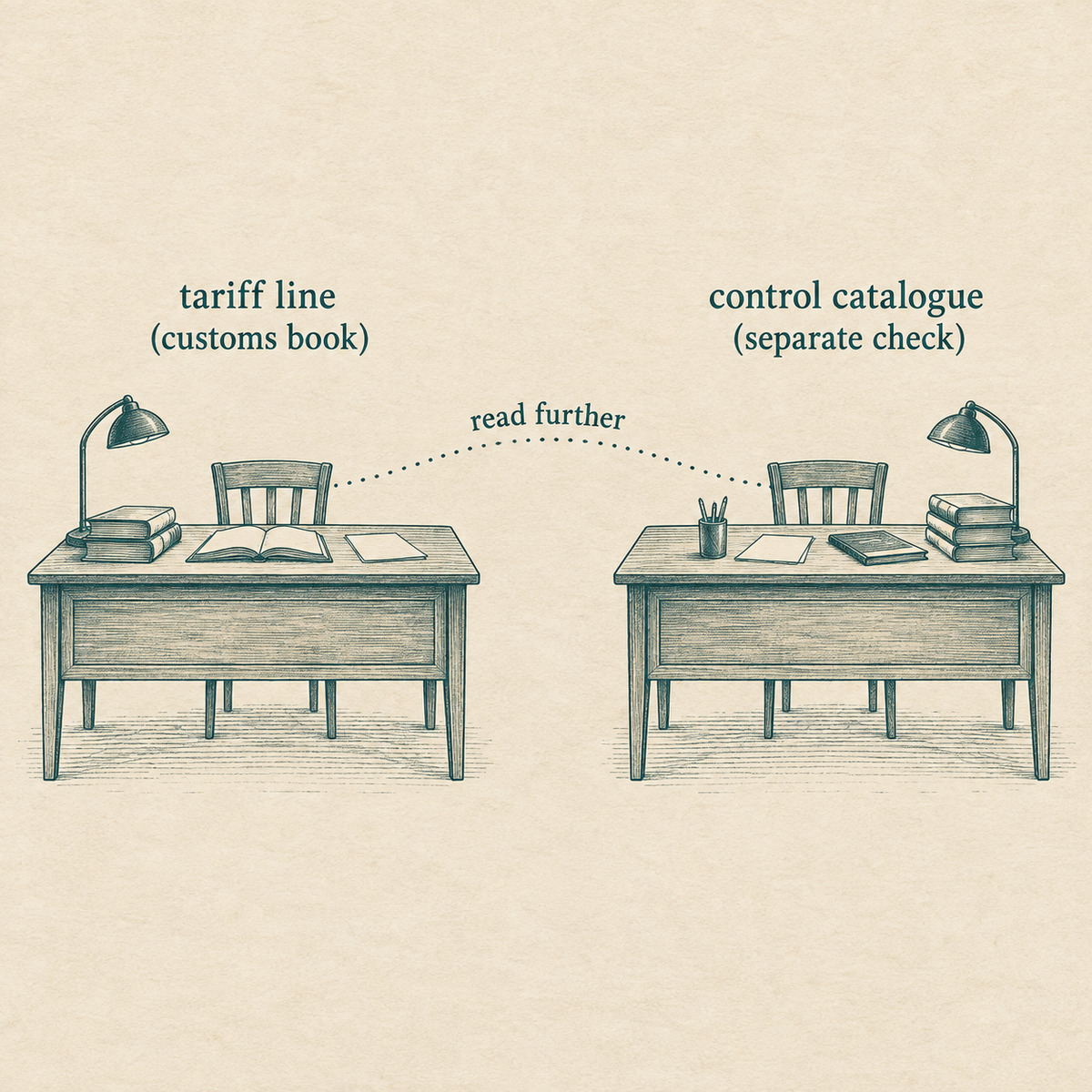
Schematic: two separate desks — a customs tariff lookup desk and an export-control catalogue desk — with no arrow implying one answers the other

What a shared six digits does not give you

You should not treat any of the following as settled just because the first six digits line up:

  1. The China 8-digit line that applies to your goods.
  2. The Chinese product description, notes or special symbols for that line.
  3. The duty, tax or preferential basis that applies on your transaction date.
  4. Whether a finer China 10-digit declaration code exists, or which one fits.
  5. Whether the item or technology falls inside a China control catalogue.
  6. Origin, quota, licence or temporary-measure status on either side.

You also keep your own country’s classification separate from China’s. A ruling or entry that settles your NCM, CN or HTS number at home does not, by itself, settle the China line. The Disclaimer states that Zhengdao provides general compliance information and that you should seek qualified advice for specific matters; that boundary applies here in full.

Frequently asked questions

Is an NCM code the same as a China tariff code?

You should treat them as relatives, not twins. Receita Federal states that the first six digits of an NCM follow the Harmonized System and that Mercosur defines the last two. China writes its own eight-digit tariff lines on the same six-digit base. You can use the shared six digits to find candidate China lines, then you confirm the Chinese description and notes before relying on any line.

Can you paste a US HTS code into a China tariff search?

You can, but you should cut it back to six digits first. The International Trade Administration says US HTS and Schedule B numbers run to ten digits and that only the first six are shared with the HS. The US tail has no meaning in China’s book. You search the six-digit stem, compare every China line inside it, and choose by product facts.

Why do the last two digits sometimes match anyway?

You may see a matching tail simply because each book subdivides the same six-digit stem with a short two-digit range, so the same numbers get reused. That overlap does not mean the authorities agreed on the same scope. Each book defines its own subdivisions with its own descriptions and notes. You read the China line’s Chinese product name and notes directly, and you never treat a matching ending as a cross-border classification.

Does a China 10-digit code replace the 8-digit line?

You use the 10-digit code as a finer declaration code that sits beneath the 8-digit line. On Zhengdao’s line pages, duty rates stay on the 8-digit line, and the ingested 10-digit children are labelled a partial corpus. You open a child when it helps you locate a candidate. When the code you need is not shown, you check the official annex instead of inventing one.

Does a matching tariff line mean your item is not controlled?

You should not draw that conclusion. A tariff line places goods in the customs book; control status is a separate question answered from control catalogues, regulations and your item’s technical facts. Some China line pages show 10-digit children sourced from a control catalogue, which is a prompt to read further, not a verdict. You run the control check separately and escalate open questions to a qualified adviser.

What should you record when you map a foreign code to China?

You record your original code and its edition, the six-digit stem you searched, every China candidate you compared, and the Chinese text that decided your choice. You add the line page’s verification stamps and the date you checked. That trail lets a reviewer or adviser test your reasoning later. It also shows you exactly what to re-check when either book changes.

Start from six digits, then read China’s own line

You now know which part of your foreign code travels and which part stays home. You bring the six-digit stem, compare every China line inside it, and read each candidate’s Chinese text, notes and stamps before you rely on anything. Control status stays a separate check. When you are ready to search, open China Customs Tariff Search and start at the subheading level.


Sources

This article is general compliance information and does not constitute legal advice; regulations are governed by the current official text.

Practical verification checklist

Scope · evidence · decision trail

Use the steps below to review this page. Verify the complete official text before making a decision. Seek qualified advice when needed.

  1. Define the decision

    State the exact decision, owner, deadline, trade direction and required evidence. Do this before you search.

  2. Identify every party

    Confirm each legal name and alias. Check registration, ownership, control, intermediaries, carriers, banks and beneficial owners.

  3. Describe the item

    Record the item’s function, operating principle, material, model and performance. Include software, technology, accessories and decisive parameters.

  4. Check classification

    Treat customs and export-control classification as separate tasks. Keep the facts, assumptions and reasoning for each result.

  5. Map the route

    Confirm origin, departure, destination and transit points. Include re-export, remote access, technology transfer and each delivery path.

  6. Verify end use

    Identify the stated purpose and real operating environment. Check integration, sensitive sectors, military links and prohibited uses.

  7. Verify end users

    Check the purchaser, consignee, end user, operator and parent company. Identify anyone who can redirect or control the item.

  8. Read the complete source

    Treat a search result as a lead. Read the official scope, definitions, notes, exclusions, annexes and licence conditions.

  9. Check current measures

    Use the version effective on the transaction date. Review later notices, temporary controls, destination measures and policy changes.

  10. Test exceptions carefully

    Prove every condition before using an exception or exemption. Apply the same rule to licence facilitation and general authorisations.

  11. Resolve contradictions

    Pause when names, codes, documents, routes, prices or explanations conflict. Obtain evidence instead of filling gaps with assumptions.

  12. Escalate uncertainty

    Send unresolved questions to the compliance owner or a qualified adviser. This includes classification, ownership, use, destination and licensing.

  13. Keep an audit trail

    Keep source links, files, checksums, screenshots, search terms and results. Record the reviewer, approvals and final reasoning.

  14. Schedule re-checks

    Set a new review date for open transactions. Re-check changing parties, destinations, specifications, official lists and licences.