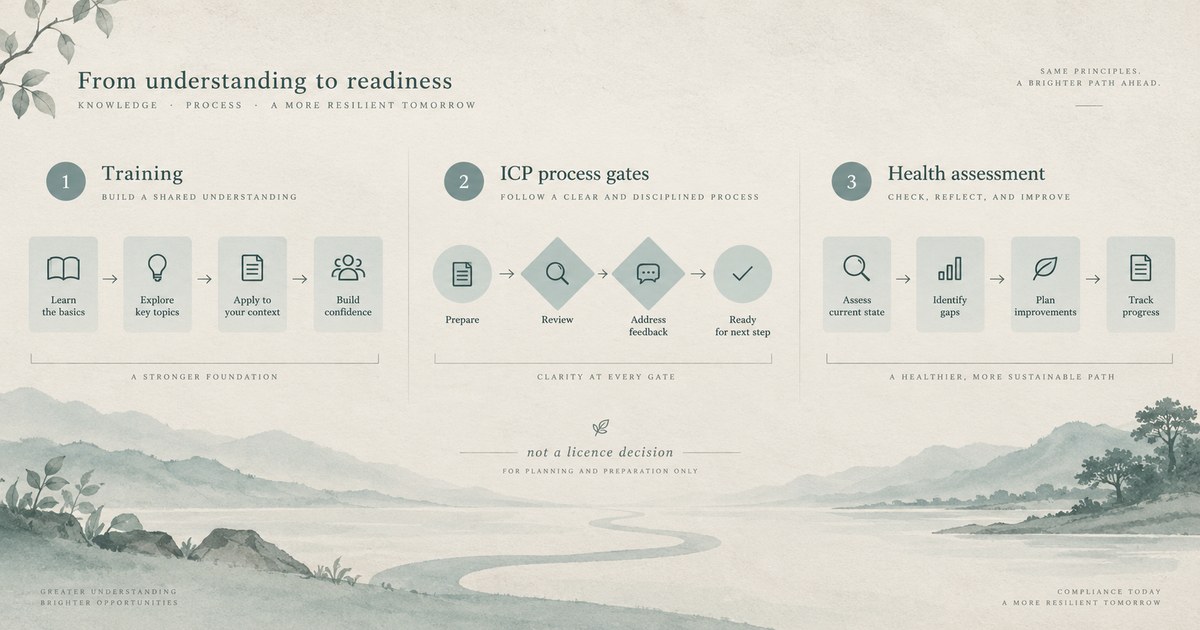
When you open Zhengdao’s compliance services, you are choosing a path to put requirements into roles, workflows and records—not collecting a licence. A completed training session or a gap list is programme work. It is not legal advice, not clearance, and not a regulator’s determination. Start with free tools when you are unsure. Escalate when the case needs counsel. This page is entry literacy, not a substitute for an official decision.
When you use services vs free self-check vs free HTML tools
You open services when gaps are already clear enough that you need structured help: role-based training, Internal Compliance Program (ICP) design, or a formal health assessment that grades risk and remediation order. Live services copy frames the job plainly—put compliance requirements into every transaction through information, training and management consulting. You treat that as delivery work after orientation, not as a stamp that finishes a licence file.
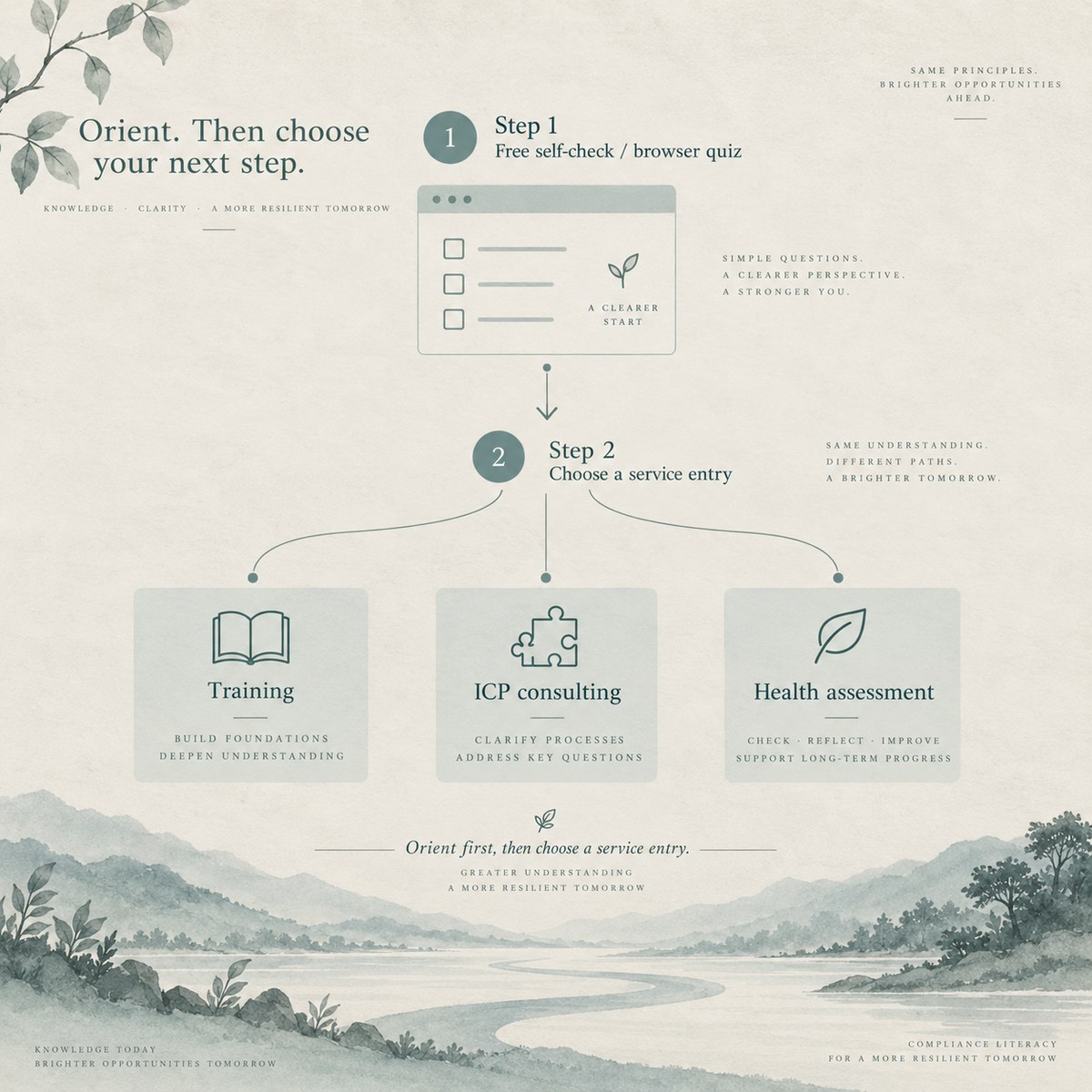
You open the free self-check when you are not sure which service fits. Live services language says exactly that: if you are unsure, begin with the free self-check; if the issue is already clear, describe the product line, role or current compliance mechanism. Keep Compliance health self-check once for that browser-local orientation. A quiz band or missing-element list is still educational reference—not certification, and not proof that services are finished.
You open free HTML tools when you need to read a regulation, screen a party name, search a control catalogue, look up a 2026 tariff line, or install the public agent corpus yourself. Those surfaces answer lookup and literacy questions. They do not replace training that builds role practice, ICP work that installs process gates, or an assessment that ranks remediation. You keep the jobs separate so a fluent tool result does not collapse into “we hired services and therefore we are cleared.”
Three entry points — training, ICP consulting, health assessment
Live services language gives you three core services and a simple match rule: training addresses whether people know what to do; ICP work addresses whether the process can operate; a health assessment clarifies risk and remediation order. You choose the entry that matches the problem you actually have—not the brochure title that sounds safest on a diligence form.
You do not invent a fourth “licence package” path that the page does not offer. You do not treat the three paths as interchangeable badges. A half-day executive session does not become an ICP manual. A gap assessment does not become a MOFCOM determination. A prioritised remediation list does not become clearance for the next shipment.
What each service delivers (from the live page only)
Training — export-control compliance training
You use training when people need role-level knowledge: regulatory framework, red-flag recognition and practical review procedures. Live scope covers executives, sales, logistics/customs, R&D and all-staff awareness programmes. Deliverables are role-based sessions, red-flag and review-workflow exercises, and product-line cases where needed. Timing on the live page is half a day for executives; half to one day for front-line teams; all-staff scope confirmed separately.
Available levels on the live page are explicit: executives cover liability and compliance governance; front line covers red flags and review-workflow practice; all staff covers export-control fundamentals and a test. You treat those deliverables as capability building. You do not treat attendance as a licence, a clearance stamp, or permission to skip a transaction review that the facts still require.
Consulting — Internal Compliance Program (ICP)
You use ICP consulting when the programme itself is thin or missing—building from scratch or systematically remediating. Live framing uses the nine-element framework: turn compliance from “words on a wall” into “gates in a process,” from policy statement to management manual. Keep The Nine Elements of an ICP: from “Words on a Wall” to “Gates in a Process” once for conceptual literacy; this article does not rewrite that essay.
Deliverables on the live page include gap assessment, review workflows and forms, record systems, and audit and continuous-improvement mechanisms. Timing is confirmed after the gap assessment defines the actual nine-element remediation scope. Core work stated on the page: assess current gaps against the nine elements; design review workflows and forms that connect with existing ERP/OA; build traceable records and ledgers retained for at least five years. You treat a gap list as a work order for process design—not as a regulator grade and not as a licence outcome.
Assessment — compliance health assessment
You use a health assessment when you need a systematic scan of product lines, customer structure and trade routes to show risk distribution and remediation order. Live deliverables are risk grading and a prioritised remediation list. Timing is confirmed according to the product-line, customer and trade-route assessment scope. If you are not sure a formal assessment is needed, the live page again points you to the free self-check for an initial tier.
You read a prioritised remediation list as an ordered backlog for owners and evidence—not as MOFCOM clearance, not as a customer diligence pass, and not as proof that classification, counterparties, end use or shipping are finished. Incomplete truth on a remediation list is still not a licence decision.
When licensed attorneys take over
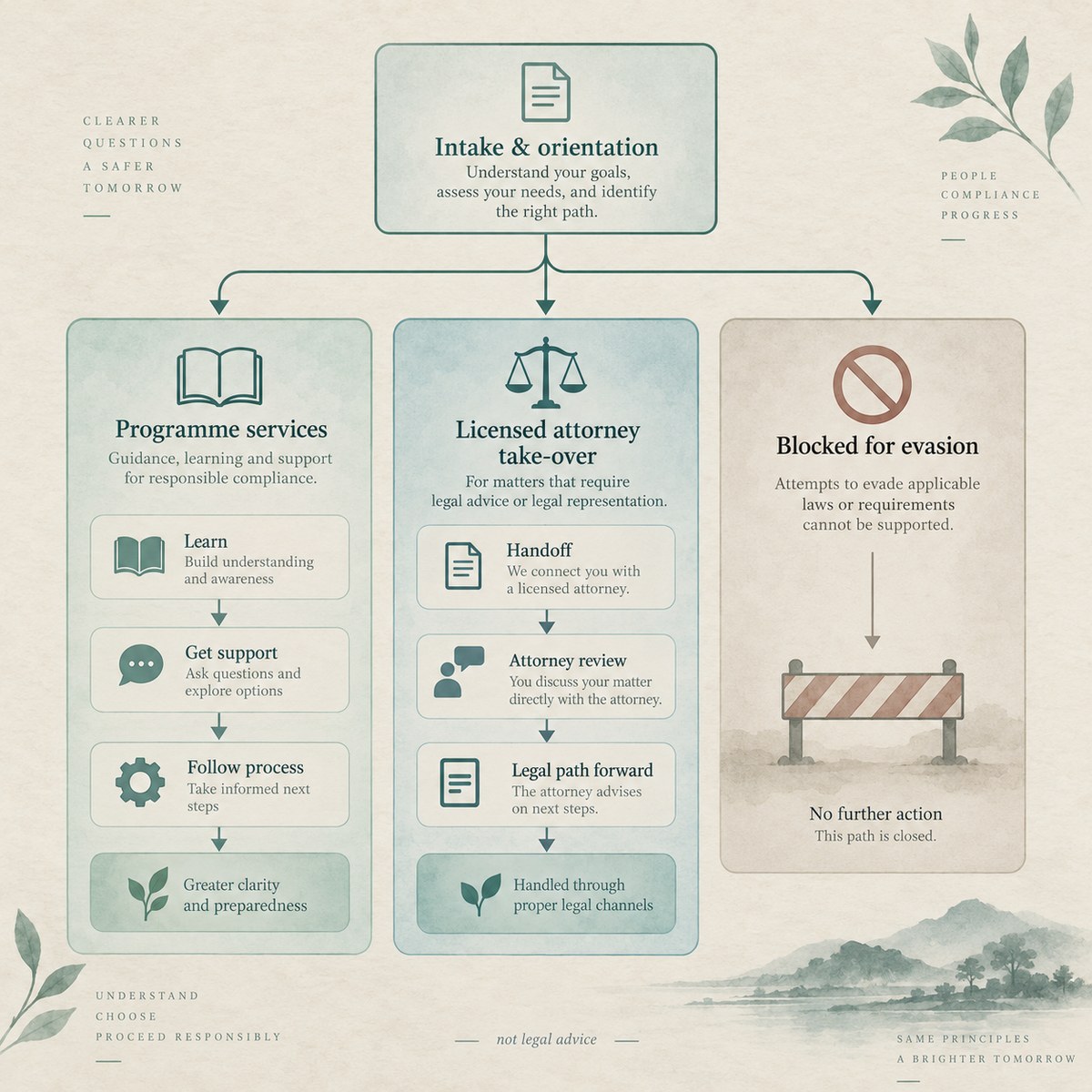
You escalate when a legal judgment is required. Live services language is clear: legal opinions, administrative-penalty response, reconsideration, criminal-risk response and compliance clauses in cross-border contracts are provided by cooperating licensed law firms. Zhengdao organises the company’s question accurately and helps embed the lawyers’ solution into day-to-day operations. Legal services are separately engaged and provided by licensed attorneys; this site does not provide legal advice.
Keep Professional teams we work with once when you need the partner-attorney surface, and Contact us once when you are ready to describe the real situation. You do not treat a training deck, an ICP gap list, or a health-assessment score as counsel’s opinion. You do not paste those artefacts into a customer form as if a licensed attorney had signed them.
Hard boundary — no evasion schemes
Live services copy states a clear boundary: Zhengdao does not provide schemes to evade export controls. No “re-label the goods” or “route through a third country” cleverness. Those tactics are themselves a major source of risk and betray the meaning of zhengdao—the right path. If that is what you are looking for, you are not looking for the right partner.
You keep that sentence beside every services conversation. Training that teaches red-flag recognition is not a how-to for hiding facts. ICP workflows that create gates are not templates for bypass. A health assessment that ranks remediation is not a map for third-country cleverness. You refuse those asks early so the rest of the engagement stays honest.
How to begin without a perfect brief
You do not need a perfect brief to start. Live how-to-begin language says: bring the real question; tell which product, customer, route, role or process concerns you most; then determine whether to begin with training, ICP work, a health assessment or a legal referral. If you are still unsure which lane fits, run the free self-check first. If the issue is already clear, describe the product line, role or current compliance mechanism through contact.
You write down what you already know and what you honestly do not. You name the decision owner and the deadline if one exists. You refuse to manufacture certainty you cannot evidence. A short, real question is more useful than a polished deck that pretends the classification, the end user and the route are settled when they are not.