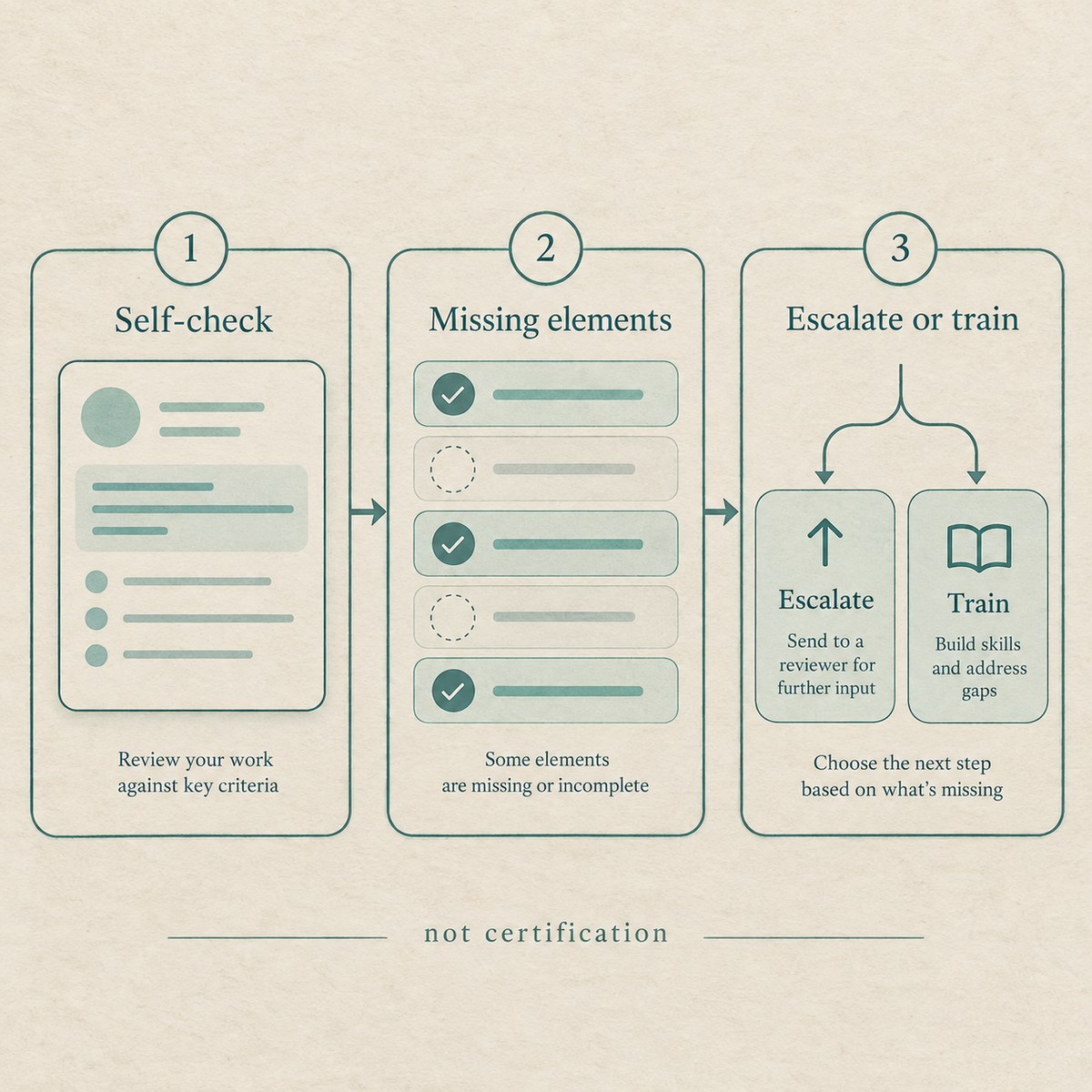
When you open Zhengdao’s compliance health self-check, you are answering nine short questions about your Internal Compliance Program—not collecting a certificate. A score or a list of missing elements is educational reference only. It is not legal advice, and it is not a regulator’s determination. Answers stay in your browser. This page is tool UI literacy, not a substitute for counsel or an audit.
When you use the self-check vs the nine-elements essay vs services
You open the self-check when you want a short, browser-local orientation on which of the nine ICP elements look thin in your own words. You open the nine-elements essay when you need conceptual literacy—how each element moves from words on a wall to gates in a process—without running the quiz. Keep The Nine Elements of an ICP: from “Words on a Wall” to “Gates in a Process” once for that reading; this article does not rewrite it.
You open services when gaps from the self-check (or from your own review) need structured help putting requirements into transactions—use Put compliance requirements into every transaction once if you are escalating after orientation, not as a badge for the quiz score. You treat these as different moments. The self-check answers “where might my ICP be incomplete under a nine-element map?” The essay answers “what do those elements mean?” Services answers a delivery path after you already know work remains. You do not collapse those jobs into one screenshot of a score.
How the nine questions map (short labels only)
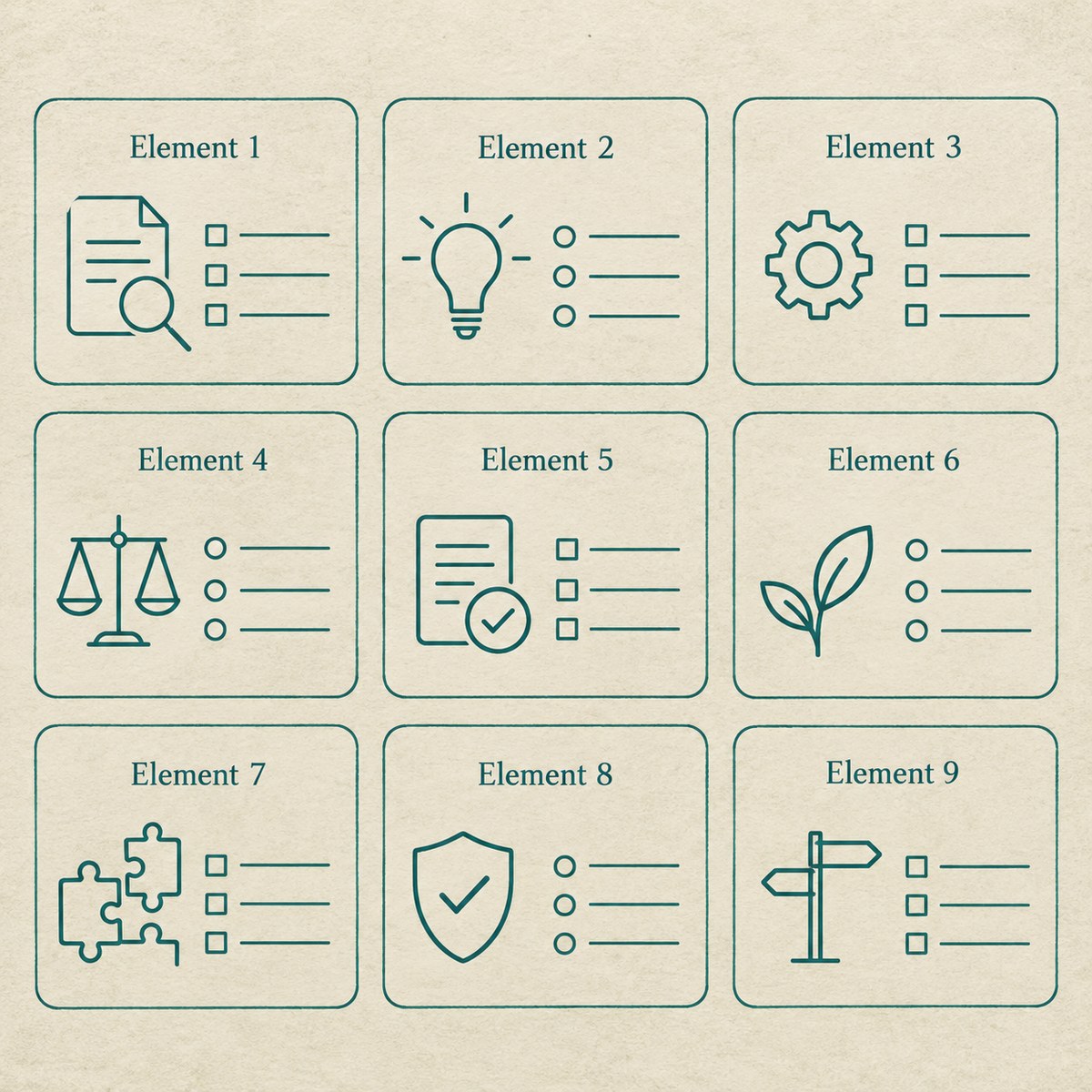
The live tool states that the nine questions map to the nine elements of an Internal Compliance Program (ICP) under China’s dual-use export-control compliance framework. You should treat each question as one element lane—not as a licence form and not as a full audit questionnaire. Short labels on the page are:
- Policy statement — signed leadership policy known to staff
- Organisation — clear compliance owner with real veto on high-risk deals
- Risk assessment — periodic grading across product, customer and destination
- Review procedures — documented product / counterparty / end-use / shipping review
- Emergency measures — stop / report / handle plan when a suspected violation appears
- Training — key roles (sales, logistics, R&D) trained for export control
- Compliance audit — internal or external check that rules are executed
- Records — review records, licences and end-user statements kept for years
- Compliance manual — written operating manual updated within a recent cycle
You do not need to paste every answer choice into your notes. Each element offers Yes / partial / None-style options so you can mark what is reaffirmed and known, what exists but is thin, or what is absent. The map is orientation. Depth still lives in your policies, workflows and the official guidelines those elements reflect.
How to answer honestly — and what stays browser-local
You answer for the organisation you actually operate, not for the organisation you wish a customer diligence form would see. Prefer “partial” or “none” when the policy is unsigned, unknown to staff, or never drilled. A generous Yes that your files cannot support trains no one and misleads the next reviewer. If two teams would mark different answers, record that disagreement—the self-check is meant to surface it, not hide it.
Live tool copy is clear on privacy of the session: answers are computed only in your browser and are not uploaded or stored by the site. You still treat the session as educational orientation, not as your firm’s permanent audit archive. If you need a durable record, you write your own note of which answers you chose and which date you ran the page—without treating that note as certification.
The tool also states the humility boundary up front: this self-check is an educational self-assessment; results are for reference only; they do not constitute legal advice; and they do not represent any regulator’s determination. Keep that sentence beside every score you show a colleague.
How to read a result without treating it as a regulator grade
After you submit, the result area summarises where you sit under the nine-element map and may list entirely missing elements—the lanes you marked as absent. Live bands speak in plain language such as a solid foundation, clear gaps, or significant exposure, with a score out of eighteen. You read those bands as a prompt for prioritisation, not as a MOFCOM grade, a licence outcome, or a third-party audit pass.
Missing elements mean the answers you gave left those lanes empty. They do not prove a regulator has opened a case, and they do not prove a customer must reject you. Likewise, a stronger band does not prove your classification is current, your counterparties are clear, or your shipping path is licensed. You re-check product classification against recent control announcements, bring weak elements up to recorded and traceable practice, and escalate when the case needs counsel—exactly the humility the result disclaimer restates: general educational information, not legal advice.
You also keep transaction red flags in a separate lane. An ICP health score is about programme elements; a red-flag stop is about one order’s facts. When a shipment shows a stop signal, keep 21 Red Flags: See Any One, Stop the Order First once and return here for self-check method. You do not treat a quiet self-check score as permission to ignore a red flag on the desk.
After gaps — escalate, train, document; do not certify
When the result lists missing or thin elements, you prioritise the lowest-cost gates that create a real paper trail—often a signed policy statement people actually know, and a documented review workflow that is not left solely to a salesperson’s judgment. You schedule training for the roles that touch export facts. You decide whether an internal check or an external assessment is next. For a fuller assessment conversation, the tool itself points toward Contact us; you use that path when orientation is finished and delivery work begins.
You refuse to screenshot a favourable band as “certified,” “cleared,” or “MOFCOM-ready.” You refuse to paste a score into a customer questionnaire as if it were an official finding. Keep Editorial and regulatory verification policy nearby when you need Zhengdao’s sourcing and “not legal advice” boundary in one place. Truth that is incomplete is still not falsehood—and a browser score that refuses to certify is doing its job.