When you open a Zhengdao China tariff page, you are reading an orientation map of ingested customs tariff rows—not a classification ruling for your goods. You search the 2026 hub by code or Chinese description, then read the 8-digit 税则号列, product name, rate columns and any ingested 10-digit children. Your match is a starting point; it does not decide classification, origin, quota or the rate for your shipment. This page is literacy only, not legal advice.
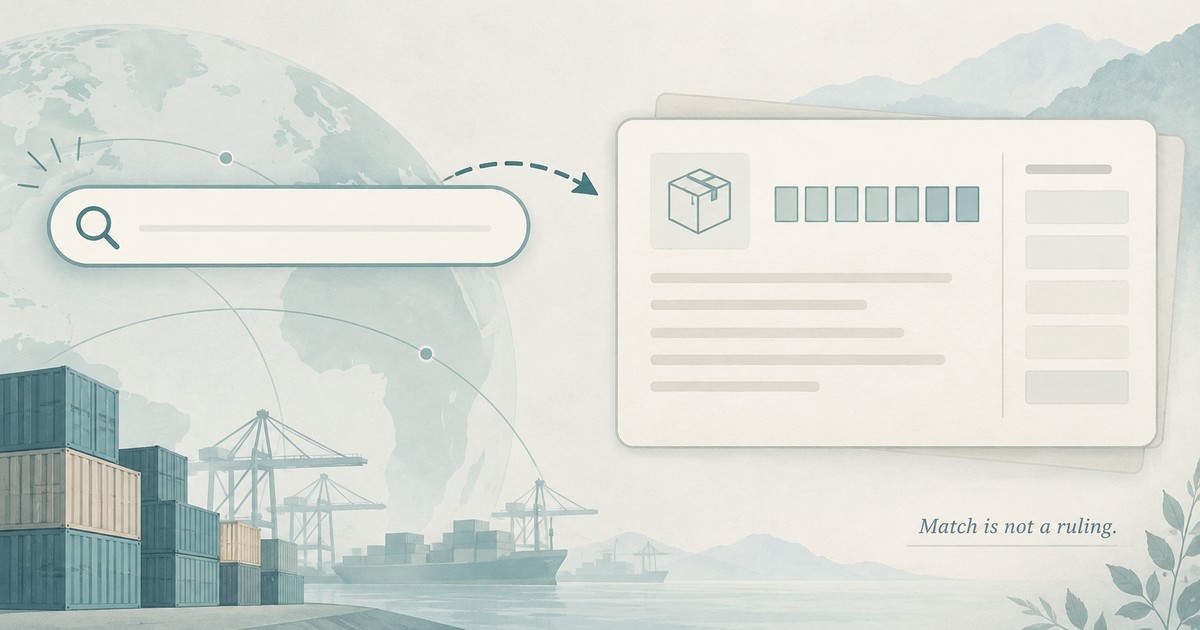
What the 2026 tariff hub searches
You use the 2026 tariff hub to narrow candidate lines from Zhengdao’s ingested China customs tariff book—not to invent a private rate sheet. On the live hub, Zhengdao discloses 8,972 8-digit tariff lines, notes that 107 lines list an export duty, states the schedule is Effective 1 Jan 2026, and records that the 8-digit book was verified 15 Jul 2026. You should treat those disclosed counts and stamps as a snapshot of what the page currently indexes, not as a claim that every later adjustment worldwide is already reflected.
You search with a tariff code (the hub supports 2-, 4-, 6-, 8- or 10-digit patterns) or a Chinese product description, then you refine until a candidate line looks worth opening. The live hub’s own boundary language says a tariff match is a starting point, not a customs declaration—you still confirm product description, material, use and specifications, and you confirm classification before you compare MFN, agreement or other rate bases. You also keep later policy changes, origin rules, quotas, notes and special symbols on your checklist after the search screen.
The hub points to the Ministry of Finance (MOF) tariff-policy release channel as source evidence for the schedule; you follow that official channel when you need the underlying publication trail, and you do not treat Zhengdao’s search card as a substitute for the governing text on your transaction date.
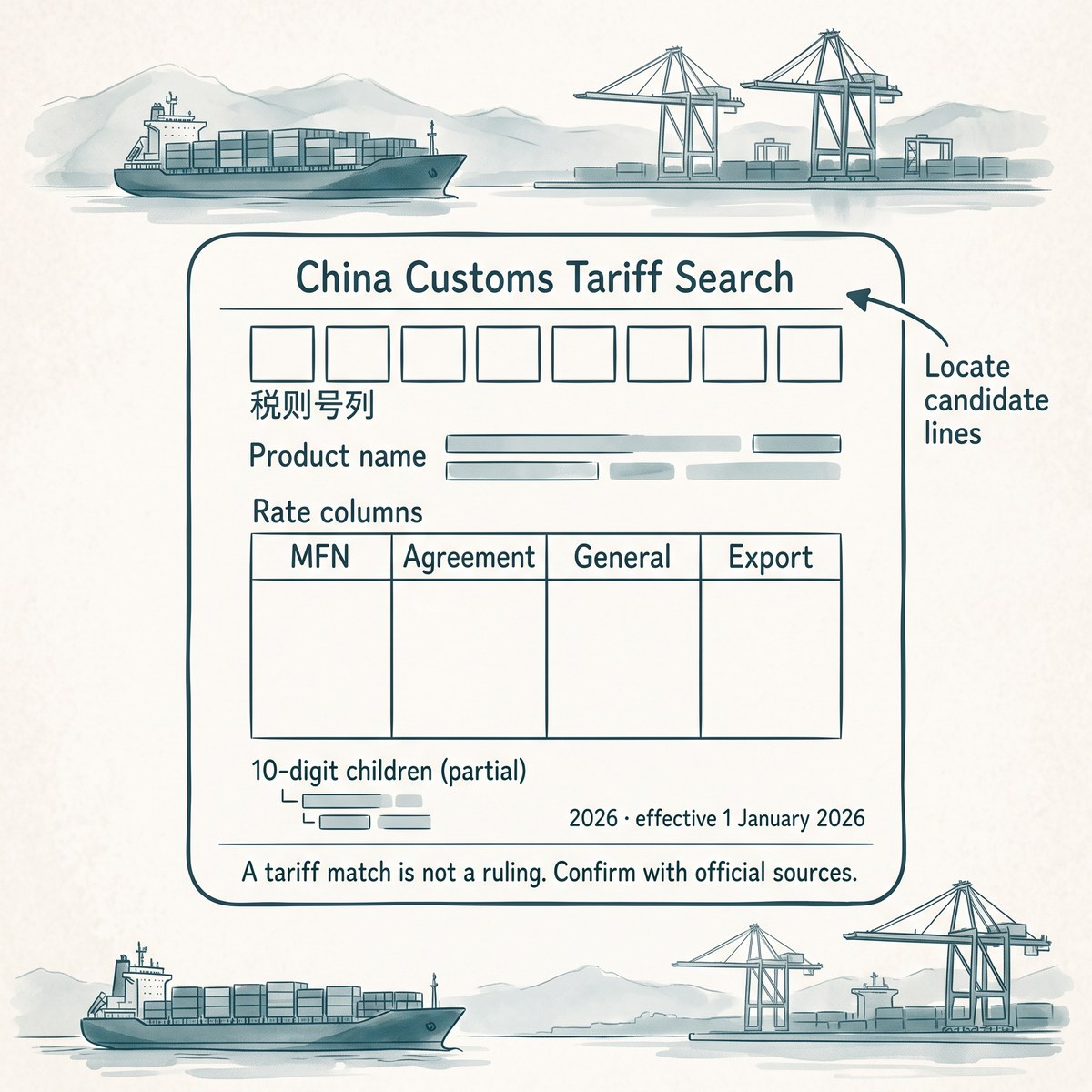
Anatomy of a line page (8-digit, name, rate columns, year)
You read a line page the way it is structured: the 8-digit 税则号列, the official product name for that row, the year and effective date, and the rate columns Zhengdao surfaces for that line—typically MFN, agreement / preferential summary, general, and export when the page has a column for that row. An illustration worth opening once is 87038090 其他, whose live H1 is the code plus the short Chinese product name “其他” in the 2026 schedule.
You use that example only to learn the layout. The page states that 8-digit tariff line 87038090 is “其他” in the 2026 schedule; that it locates the line and any ingested 10-digit children; and that it does not decide classification, origin, quota or the rate that applies to a shipment. You likewise see the year stamp 2026 · effective 1 January 2026 and the verification note that the 8-digit book was last verified on 2026-07-15. You re-check those stamps on the live page whenever you return—draft-day figures are not permanent coverage.
What ingested 10-digit children mean (and do not)
You treat ingested 10-digit children as a partial official corpus, not as a complete national 10-digit book. On the example line page, Zhengdao states that official 10-digit children opened on 2026-08-24 are a partial corpus; the hub similarly frames 10-digit children as partial. You open a child row when it helps you locate a finer declaration code that Zhengdao has ingested—you still do not invent missing children, and you do not assume every national 10-digit split is present.
You also keep VAT, consumption-tax and footnote trails in their disclosed lanes when the page shows them. Your job on the children block is location and humility: find what was ingested, compare it with your product facts, then escalate when the finer code you need is absent or when the official annex still controls footnotes and special methods your shipment requires.
A match is not a classification ruling—or a rate for your shipment
You should treat every tariff-line match as orientation, not as a finished “this is your HS / this is your payable rate” answer for your exact goods. The live line page states plainly: “A tariff-line match is not a classification ruling.” The hub says the same idea in starting-point language: a match is not a customs declaration. You still check the general rules, section/chapter/subheading notes and later official adjustments before you use a rate.
You likewise remember that origin, preferential-programme eligibility, quotas, temporary measures and other authorities can still change what applies after you find a neat row. Your screenshot of an 8-digit line and its rate columns is a lead for verification—not a substitute for the latest official documents or qualified advice on a specific shipment.
When you should leave the tariff lane
You stay on the tariff hub and line pages when your question is “where does this code or Chinese description sit in Zhengdao’s ingested 2026 China customs tariff book, and what rate columns and children does the page disclose?” You leave that lane when your real question is whether a customs tariff code is the same kind of identifier as a dual-use or other control code—then you open HS Codes vs Control Codes: When Tariff Lookup Is Not Enough once for that conceptual split, not as a rewrite of this UI walkthrough.
You also leave the tariff lane when your question is about a product or technology control measure rather than a tariff-row layout—then you open Does your product or technology appear in a China import/export-control catalogue? and still treat every catalogue hit as a lead. On example lines, Zhengdao may show related control-catalogue status such as “No ingested control-catalogue item is keyed to this 8-digit line. That is not a clearance.”—you read that as an ingestion boundary, not as permission to ship.
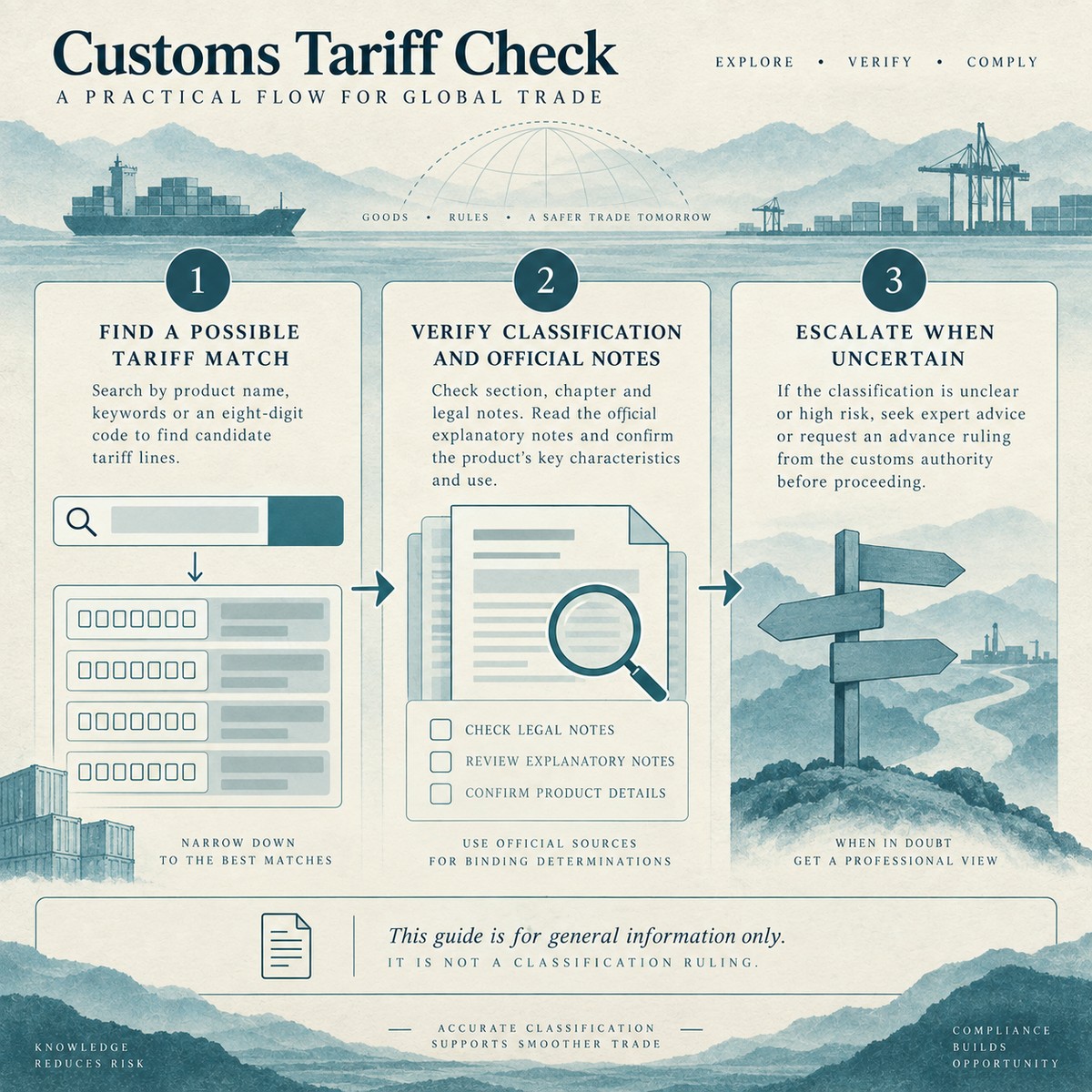
Keep Editorial and regulatory verification policy open when you need Zhengdao’s sourcing and “not legal advice” boundary in one place. Your workflow stays: orient on tariff pages, switch tools when the question changes, verify official text, then escalate.
Orient on the tariff hub—then verify before you declare
When you are ready to search a tariff code or Chinese product description—and to treat every line as orientation rather than a ruling—open China Customs Tariff Search and keep match humility beside you. You are using Zhengdao’s 2026 tariff pages to locate ingested rows and disclosed columns, not to finish classification or rate selection for your shipment. Orient, verify the official text and notes, then escalate when your case needs a judgment these pages cannot give.