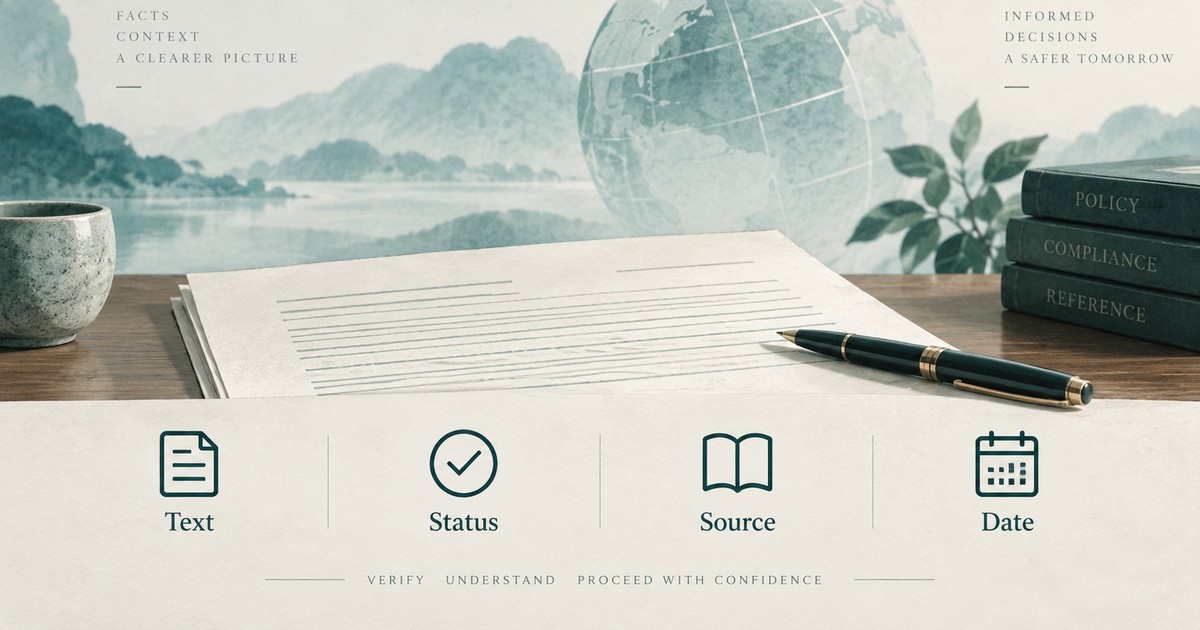
When you open Zhengdao’s editorial and regulatory verification policy, you are reading how the site checks its own content—not collecting a legal opinion or a control determination. The page tells you who prepares material, how official text and status are checked, and when an article is lawyer-reviewed. It is not legal advice, not a licence decision, and not a certificate for your transaction. This guide shows you how to read that policy without treating verification as counsel.
What the editorial policy is for
You use this policy when you need to know what “verified” means on Zhengdao before you rely on an article, a regulation note, or a date stamp. Live copy says content is prepared by the Zhengdao AI Compliance Research Team and that Zhengdao.AI is responsible for editorial verification. You read that as an editorial duty—who checks sources and status—not as a sign-off on your facts by a lawyer or a government authority.
You keep the endorsement rule beside that duty. Unless a named lawyer and firm are shown, you do not treat an article as endorsed by a lawyer or a government authority, and you do not treat a checklist or a date stamp as a ruling on your transaction.
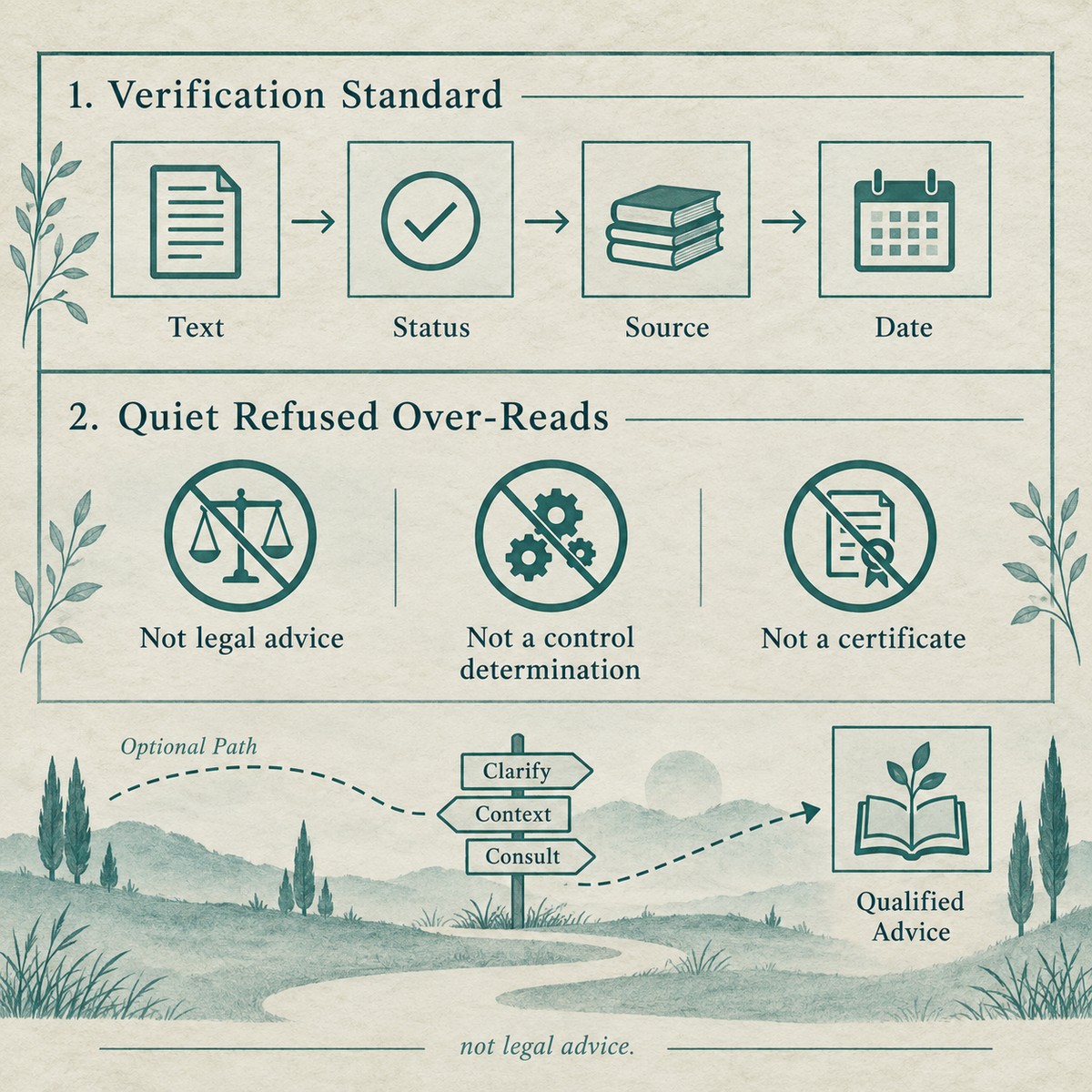
You also keep the job narrow. It does not classify your item, name your parties, or decide whether a measure applies to your route. When a legal judgment is required, you seek qualified advice separately.
The verifiable workflow — official text, status, sourcing, and dates
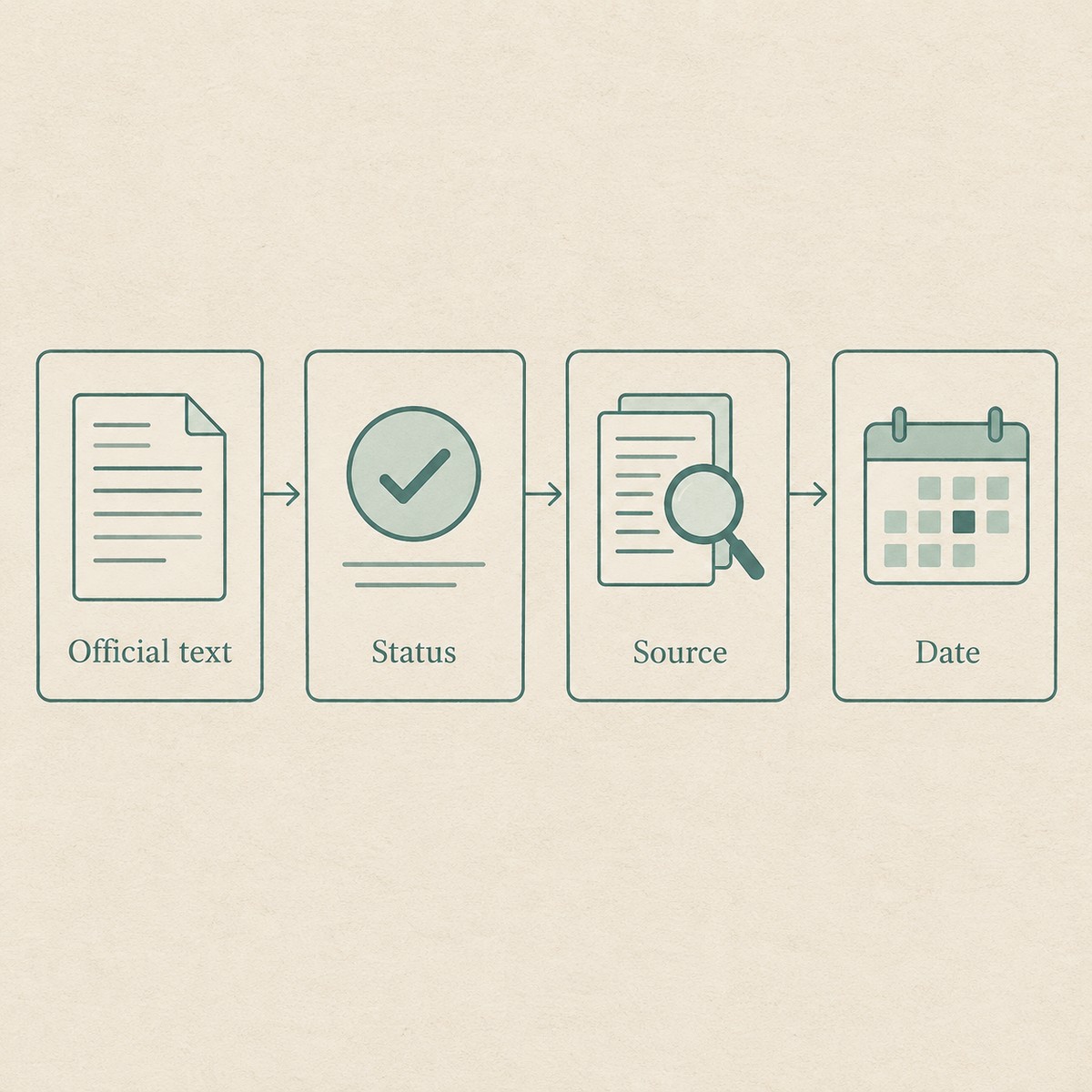
You can read the workflow as four checks the page actually names.
You start with official text first. Laws, administrative regulations, and announcements should link to primary sources from the NPC, the State Council, MOFCOM, or other issuing authorities. You treat a secondary recap or a generic homepage as a pointer, and you still open the issuing authority’s text before you rely on it.
You then check status separately. The page says commencement, amendment, repeal, suspension, and resumption are looked for—not merely the publication date. You do not treat the publication date as proof the text is in force for you.
You look for claim-level sourcing. Material conclusions should link to the specific official document that supports them, rather than a generic homepage. If you cannot see that link, you find the source yourself before you rely on it.
You keep dates visible. Articles show their publication or last-verification date, and the regulation library shows its last review date. A visible date tells you when the site last checked its copy. It does not tell you that your transaction is covered.
Boundary with legal advice
You read the boundary before you reuse any article. The page states that this site provides general compliance information, educational material, and self-assessment tools, and that it does not issue a legal opinion on a specific transaction. You keep that limit on every citation you copy.
You treat lawyer review as express, not implied. An article is lawyer-reviewed only when it expressly names the lawyer, the law firm, and the review date. If any of those is missing, you do not describe the piece as counsel’s work on your facts.
You keep the site disclaimer beside that boundary when you need the fuller statement that content is not legal advice. Keep Disclaimer once for that surface. You do not ask either page to decide your matter.
When you need a legal opinion, administrative reconsideration, or litigation representation, you look to cooperating licensed law firms under separate engagement—not to an unsigned article. Keep Professional teams we work with once. You do not paste a policy paragraph into a form as if a named firm had signed your file.
How corrections work
You use the corrections path when you find an incorrect source, status, or statement. The page tells you to use the contact page and include the primary source. It says substantiated errors are verified and corrected, and that material status explanations are retained. You send the official text that shows the problem.
Keep Contact us once for that intake surface. You still treat an email as a correction request, not as legal advice and not as a control determination. You include the primary source the policy asks for.
You do not treat a published correction as a control determination. A fixed citation means the article’s source or status was addressed. It does not mean your item, your party, or your route has been decided for you.
How to read the practical checklist
You will also see a practical verification checklist on the policy page, headed scope, evidence, and decision trail. It tells you to verify the complete official text before you decide and to seek qualified advice when needed. You treat the checklist as a reading aid, not a scoring engine and not a certificate.
Among the steps the page lists, you define the decision, identify parties, describe the item, and map the route before you rely on a hit. You keep customs classification and export-control classification separate. You read the complete source and the version effective on the transaction date, test an exception only when every stated condition is proved, pause on conflicts, keep an audit trail, and schedule a re-check.
You do not skip the warning inside those steps. “Prove every condition” is not a finding that an exception applies to you, and nothing in the list names your product or your outcome.
What the policy does not grant
You finish verification literacy with the refusals the page already states for you.
- Not legal advice. General information does not become a legal opinion on your transaction.
- Not lawyer endorsement by default. Unless the article names the lawyer, the firm, and the review date, you do not claim endorsement by a lawyer or a government authority.
- Not a control determination. Links, status checks, and visible dates do not classify your item or decide your route.
- Not a certificate. A last-verification date or a finished checklist is not approval of your facts.
- Not evasion help. You do not use this page, or a correction email, to seek a scheme around export controls, customs supervision, or sanctions.
You still verify the current official text yourself, and you escalate when classification, ownership, use, destination, or licensing is unresolved. The policy tells you to do that. It does not do it for you.
Editorial policy vs disclaimer, contact, About, team, and the library
You keep the surfaces separate so one verification page does not collapse into every other page you open.
You open the editorial policy for the verification standard: official text, separate status, claim-level sourcing, visible dates, the lawyer-review rule, and corrections. That standard is the main call to action after the questions below.
You open the disclaimer for the site-wide legal boundary. You already keep that link once, and you do not treat either page as counsel for your file.
You open contact when you are reporting an incorrect source, status, or statement and you can include the primary source. You do not open contact to ask for a determination the policy refuses to issue.
You open About when you need who operates the site and how information work is divided from legal services. Keep About Zhengdao once. You do not treat About as the verification workflow.
You open the regulation library for the surface whose last review date the policy tells you to expect. Keep China Export-Control Regulation Library once. A review date is a maintenance stamp, not a statement that every instrument is in force for your facts.