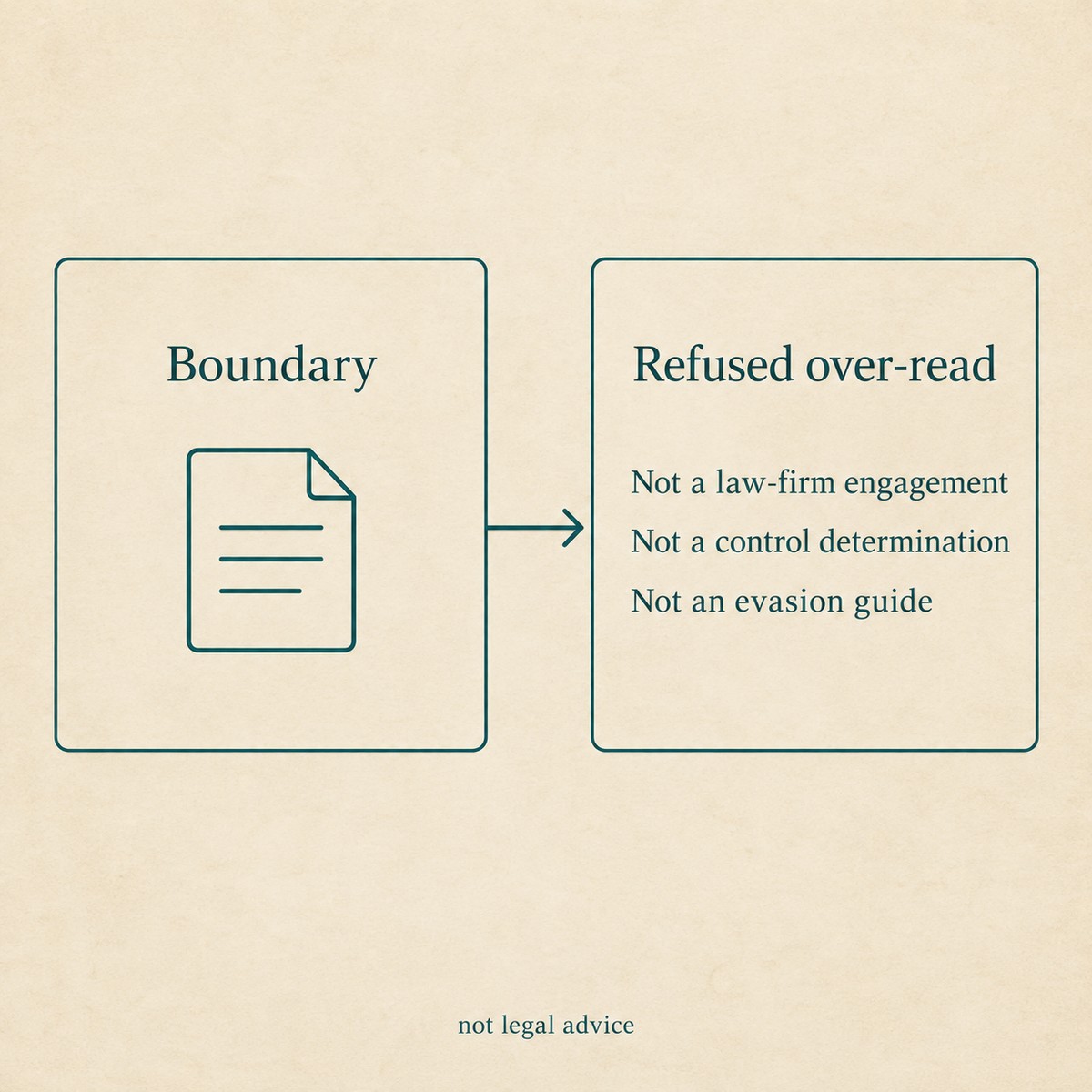
When you open Zhengdao’s disclaimer, you are reading a site-wide boundary, not hiring a law firm and not collecting a legal opinion on your matter. The page says the operator is not a law firm, that content is general information, and that legal opinions, administrative reconsideration, and litigation representation sit with cooperating licensed law firms under a separate engagement. It is not legal advice, not a control determination, and not an evasion guide.
What the disclaimer page is for
You use this page when you need the site-wide limit on what zhengdao.ai content can be for you. The live heading is Disclaimer. Six statements cover legal advice, legal services, official text, the self-check, evasion, and external links. You read them before you reuse an article, a list, a date, or a tool result. Nothing there names your item, your route, or your licence outcome, and the page does not perform a legal judgment for you.
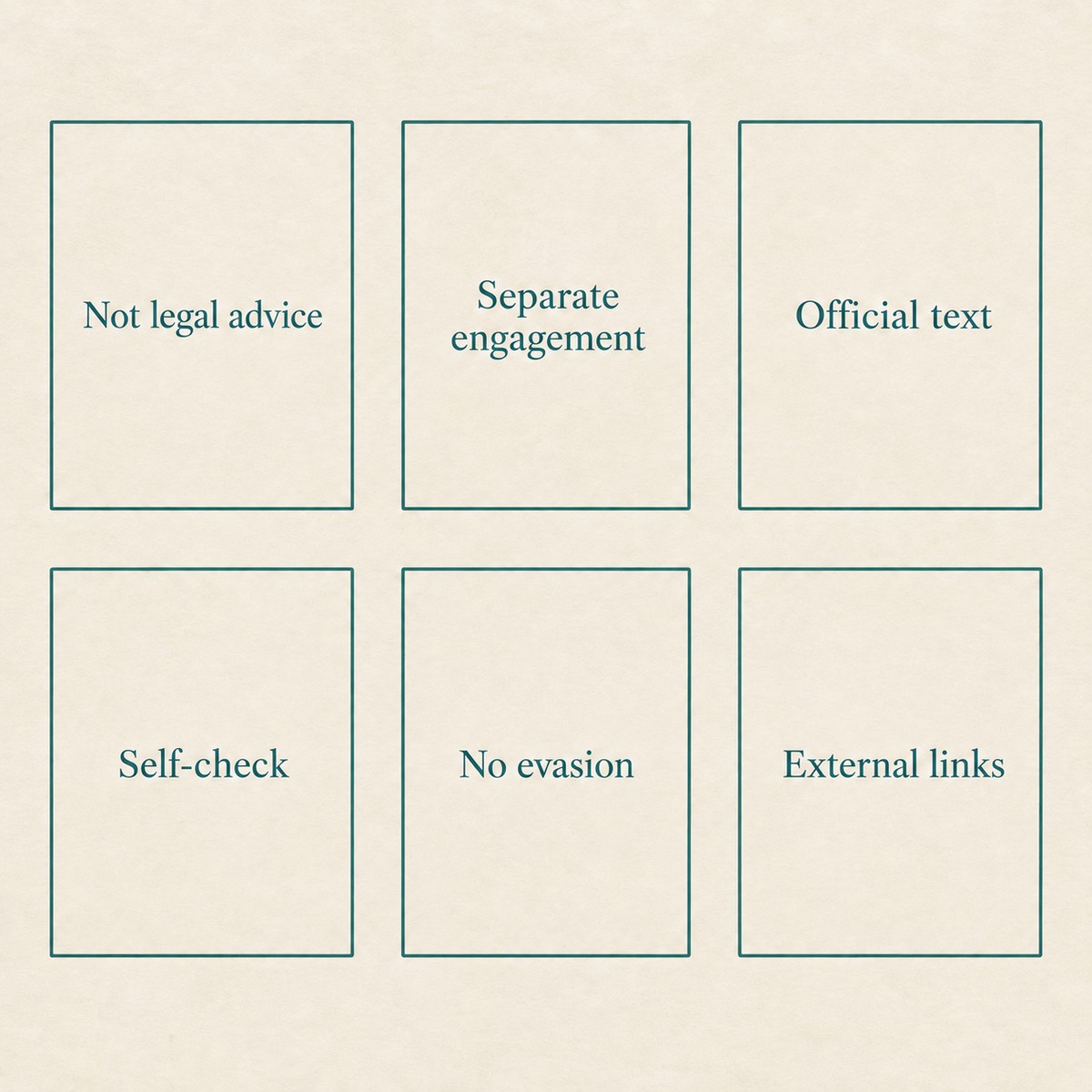
Six statements the live page actually makes
You can hold the disclaimer to the six labels it prints. You do not add a promise the text does not make.
- Not legal advice. You read that all content on zhengdao.ai—including articles, regulation lists, and the self-check tool and its results—is general compliance information and educational material. It does not constitute legal advice or any judgment or promise on any specific matter.
- Legal services by licensed attorneys. You read that the operator is not a law firm and does not provide legal services. Legal opinions, administrative reconsideration, and litigation representation are handled by cooperating licensed law firms under separate engagement.
- Official texts govern. You read that regulatory information carries a source and a last-verified date, that laws and regulations are continuously updated, and that any citation is governed by the current, official published text.
- Nature of the self-check tool. You read that the compliance self-check is an educational self-assessment. Its results do not represent any regulator’s determination and cannot replace a professional assessment.
- No evasion schemes. You read that the site provides no scheme or advice for evading export controls, customs supervision, or economic sanctions, and that it declines to provide services for such purposes.
- External links. You read that links to third parties, including government sites, are there for convenience, and that the site is not responsible for third-party content.
You stop there. The page does not name a fee, a certificate, or a lawyer assigned to your file. A shared prompt under the six statements tells you to verify the official text and seek qualified advice. You treat that prompt as a reminder, not as a control determination.
Not legal advice, and not a judgment on your matter
You apply the first statement whenever you reuse the site. An article, a regulation list, and a self-check result stay general information. The page gives you no exception for a hard product or a tight deadline, and you do not paste the sentence into a filing as counsel’s view.
The operator is not a law firm
You read the second statement as an identity limit, not as a contract you just signed. Opening the page or finishing a self-check does not make the operator your law firm. You do not stretch “etc.” into services the bullet never names.
Open Professional teams we work with once. It lists Hiways Law Firm (Shanghai) among independently operated partner organisations, says Zhengdao AI does not provide legal advice, handles initial contact through hi@zhengdao.ai, and says legal services are separately engaged with the relevant licensed provider. A name on that list is not counsel retained for your file.
Keep About Zhengdao once for the operator. It says Zhengdao.AI, which operates the site, is a China trade-compliance information and consulting service, that nothing on the site constitutes legal advice, and that you should see the full disclaimer. The same legal matters stay under separate engagement. You use About to see who operates the site, not as an engagement letter.
Keep Contact us once if you write to hi@zhengdao.ai. That page says it replies within two business days and asks you not to send identity documents or original licences in a first email. Your email is an enquiry, not the separate engagement required before anyone represents you.
Official text governs your citation
You read the third statement as a citation rule, not as a verification manual. A source and a last-verified date sit on regulatory information, but any citation is governed by the current, official published text, and the page says the operator is not liable if you rely on the site without that check. A date is not proof the text is in force for your facts, and it does not classify your item.
Keep Editorial and regulatory verification policy once if you need who checks an article. That page says the site does not issue a legal opinion on your specific transaction. On the disclaimer, do not cite Zhengdao in place of the current official text.
The self-check is not a regulator’s determination
You read the fourth statement on its own terms. The compliance self-check is an educational self-assessment. Its results do not represent any regulator’s determination and cannot replace a professional assessment. You may see which questions you have not answered. You may not treat the screen as a control determination, a certificate, or legal advice. The page does not describe the tool’s questions or scoring, and you do not invent them.
No evasion reading
You read the fifth statement as a refusal, not as a method. The site gives you no scheme for evading export controls, customs supervision, or economic sanctions, and it declines services for that purpose. You do not hunt a tool result or an email for a workaround, and you do not relabel the refusal as permission.
External links are not endorsements
You read the sixth statement before you follow a link. Third-party links, including government sites, are for convenience, and the site is not responsible for third-party content. You do not treat a government link as Zhengdao’s adoption of that page. If the pages differ, you go to the official text, and you consult a licensed attorney when the difference is your legal matter.
What the disclaimer does not grant
You leave with the limits the page states, not with extras you wish it stated.
- Not a law-firm engagement. You do not become a client by opening the page.
- Not legal advice. Lists and self-check results you reuse are not a judgment on your matter.
- Not litigation representation. Reconsideration and litigation representation still need a separate engagement for you.
- Not a control determination. A date or a self-check result does not classify your item.
- Not an evasion guide. The page refuses you any scheme for evading export controls, customs supervision, or sanctions.
- Not a third-party endorsement. A convenient link is not the official text for you.
You can still read the site as general information. You do not promote that reading into counsel or a certificate.
Disclaimer versus the editorial policy, team, About, and contact
You keep each surface in its lane. You open the disclaimer for the six statements, and that page is the call to action after these questions. You open the editorial policy for verification, the team page for independent partners, About for who operates the site, and contact for an enquiry—not for representation the disclaimer says the operator does not provide.