When you look up a China tariff line or search a licensing catalogue by HS, you are using a customs navigation tool—not finishing an export-control determination. HS / customs commodity codes and dual-use control codes answer different questions. Your tariff hit can orient clearance research; your control-code path must still follow the governing list, technical parameters, and official text. This page is orientation only, not legal advice.
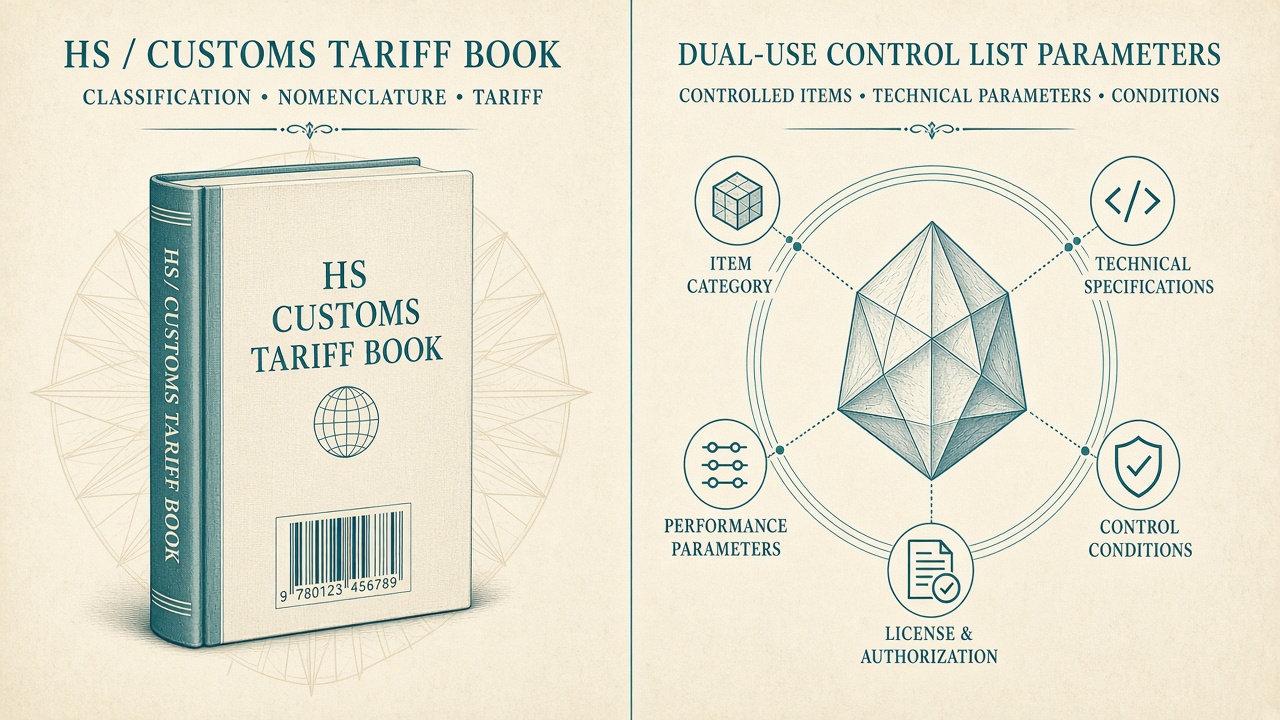
What an HS / customs commodity code is for on Zhengdao
You use an HS or China customs commodity code on this site to locate a tariff-schedule line and related duty orientation for a goods description year. A Zhengdao tariff page helps you find the line, any ingested children, and rate summaries the site has structured from the official book. It does not decide classification, origin, quota, licence status, or the rate that applies to your shipment.
You should treat a tariff-line match as a lead for customs commodity research, then verify the general rules, notes, and later official adjustments before you rely on a figure. For a live illustration of that boundary—not a sample determination—open 87038090 其他 and read the page’s own “not a classification ruling” framing. Your customs lookup and your export-control classification remain separate tasks even when the same eight- or ten-digit string appears in both workflows.
What a dual-use control code is for
You use a dual-use control code to identify an entry on China’s dual-use control architecture—typically against the Dual-Use Item Export Control List and related announcements—so you can compare your item’s function, materials, and decisive technical parameters with the controlled description. Control codes organise controlled goods, technologies and related items for classification and licensing review. They are not a shortcut that replaces reading the item name, description, notes and thresholds.
If you still need the company baseline—what dual-use means, the law-and-regulation frame, and why lists change—read Dual-Use Export Controls in China: the Baseline Every Company Needs once, then return here for the HS-versus-control-code method. Your primer gives framework; this article teaches why tariff lookup alone is not enough for control status.
Does an HS hit in a licensing catalogue prove the item is controlled?
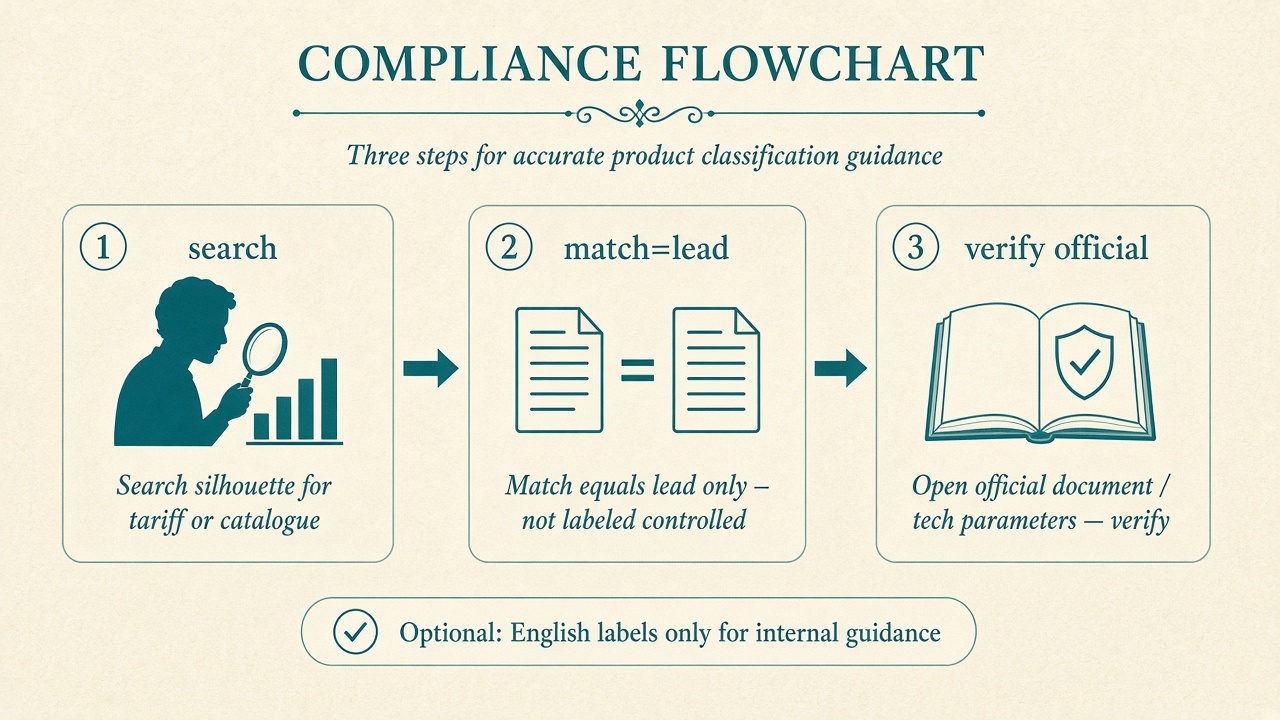
You should not treat an HS hit inside a dual-use import/export licensing catalogue as a final control determination. Official MOFCOM guidance states that customs commodity numbers are not the basis for deciding whether an item is dual-use; the Dual-Use Item Export Control List and the assigned control codes frame classification and licensing, and catalogue HS fields mainly help operators and agencies map controlled descriptions to customs practice. A catalogue row that shows your HS is a verification lead: you still open the official item description, parameters, exclusions and the current measure effective on your transaction date.
You also keep Zhengdao’s own catalogue boundary in view: a match means verify against the official text; a tool result is for quick location, not counsel. Your file should record which code you searched, which official entry you opened, and what parameters still need engineering confirmation.
Does “no HS listed” mean uncontrolled?
You must not read a missing or blank customs commodity number as “uncontrolled” or “licence-free.” MOFCOM’s published Q&A on this point explains that licensing-catalogue items and technologies require dual-use import/export licensing in accordance with law whether or not a customs commodity number is listed, and that some controlled entries still lack assigned HS while others share the same HS across different control codes and thresholds. Your empty HS search therefore under-reads risk if you stop there.
You likewise remember destination, end use, end user and catch-all style review can still matter after a list miss. No HS in a catalogue index is not a clean bill for your SKU.
Common failure modes you should stop early
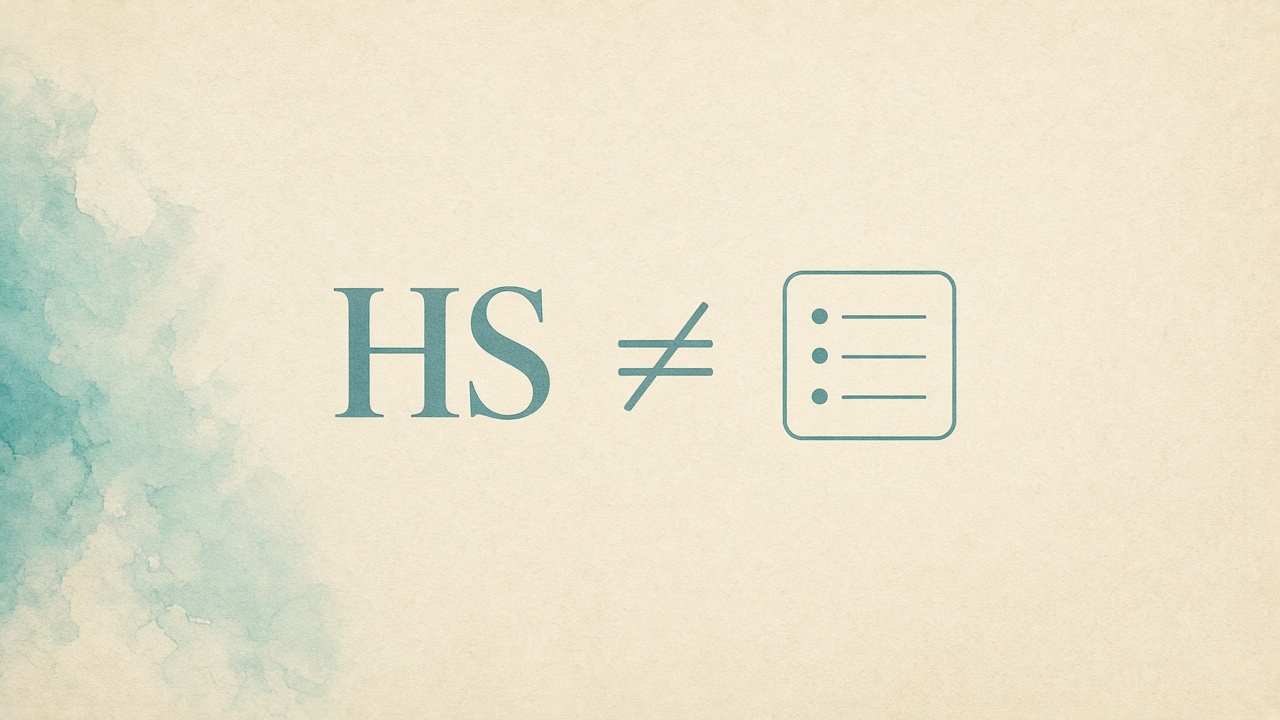
You over-read when you equate “same HS as a catalogue row” with “definitely controlled for my exact model,” without checking technical thresholds that split two control codes. You under-read when “no HS in the index” becomes “ship freely,” ignoring control-list text and later destination measures. You also fail the workflow when you finish tariff research and never open control-code or end-use questions, or when you invent a sample determination from a screenshot instead of keeping assumptions explicit.
Minimum workflow for one SKU (no sample determinations)
You run a short, repeatable path for one SKU without pretending the path is a ruling:
- Write the decision. You state export or import, owner, deadline, and what evidence you need before you search.
- Describe the item. You record function, operating principle, materials, model, software/technology, accessories and decisive parameters—not only the commercial name.
- Separate the two classifications. You complete customs commodity / HS orientation for clearance research; separately you assess dual-use control against current list text and control codes.
- Search as a lead. You use catalogue, control-code and (if useful) HS fields on Zhengdao as location aids; treat every hit or miss as incomplete until you read the official source.
- Open the governing text. You verify scope, definitions, notes, exclusions, annexes and licence conditions against the version effective on your transaction date.
- Add route, end use and end user. You confirm destinations, transit, stated purpose and who can redirect the item; escalate contradictions instead of filling gaps.
- Keep an audit trail. You save sources, dates, search terms, open questions and the reviewer who must decide next.
When your description is still too thin for a defensible screen, use Find the missing facts before you decide the control status. to turn unknowns into follow-up questions and a hand-off brief—still a screening lead, not a classification opinion. Your next step after any on-site tool is official-text verification and, when stakes require it, qualified counsel.
Open the catalogue—verify official text next
When you are ready to search by product name, technology, HS or control code—and to treat every result as a lead—open Does your product or technology appear in a China import/export-control catalogue? and keep tariff lookup in its lane. You are separating HS codes from dual-use control codes so tariff research never masquerades as a control ruling. Orient on Zhengdao, verify the official text, then escalate when your case needs a judgment these tools cannot give.
Frequently asked questions
What is an HS / customs commodity code for on this site?
You use HS and China customs commodity codes on Zhengdao to orient tariff-line research for a goods year—finding the schedule line, related summaries and pointers the site has structured. They support customs commodity navigation. They do not finish dual-use classification, licence decisions or a shipment ruling. Your tariff page is a map to the official book, not the book’s substitute for every footnote.
What is a dual-use control code for?
You use a dual-use control code to locate and compare against controlled item descriptions on China’s dual-use list architecture, including technical parameters that decide whether your SKU falls inside an entry. Control codes organise classification and licensing review. They do not replace reading the official description, notes and current announcements. Your comparison must use the item’s real performance facts, not a marketing label alone.
Does an HS match in a licensing catalogue prove control?
You should treat an HS match as a lead only. Official practice and MOFCOM guidance emphasise that customs commodity numbers are not the determination basis for dual-use status; control-list entries and control codes carry the classification logic, while catalogue HS fields aid mapping. Your match still requires reading the official text and parameters for your exact item. Do not file “HS matched = controlled” as a finished answer.
Does no HS in the catalogue mean the item is uncontrolled?
You should not conclude that. Licensing-catalogue items can require dual-use licences whether or not an HS is listed, and some controlled entries lack assigned customs numbers or share one HS across different control thresholds. Your empty HS result is incomplete without list-text and parameter review. Destination, end-use and catch-all questions can still apply after a miss.
What should you do next on Zhengdao?
You should open the import/export-control catalogue for item, HS or control-code location; use a live tariff page only for customs orientation; and use item screening when facts are missing—then verify official sources before any licence or shipment decision. Keep customs and export-control classification in separate evidence trails. Escalate uncertainty instead of inventing a determination from a search screenshot.
Sources
- Import/export-control catalogue (Zhengdao) ↗
- Dual-use primer (Zhengdao) ↗
- Tariff example 87038090 (Zhengdao) ↗
- Item screening (Zhengdao) ↗
- MOFCOM FAQ on dual-use / customs commodity numbers (official) ↗
General compliance information, not legal advice. The official, currently effective text prevails.